For Independent Food Distributors

Retail Margin Calculator

Enter what a unit costs the store and what it rings up at. Get the retail margin, the markup that means the same money, and the shelf price a target margin needs.
VoiceOrder app ordering screen

Retail Margin Calculator

The retail margin formula is simple. The markup that produces it is not. Put in a cost and a shelf price to see both, plus the price a target margin actually needs.

The unit on the shelf

$
What the unit costs the store, which is your case price split out.
$
What it rings up at. Retail margin is the share of this the store keeps.

Target and volume

%
Most grocery categories sit between 25% and 45%.
units
Used to turn the per unit figures back into a case.

Monthly movement

cases
How many cases of this item move in a month.
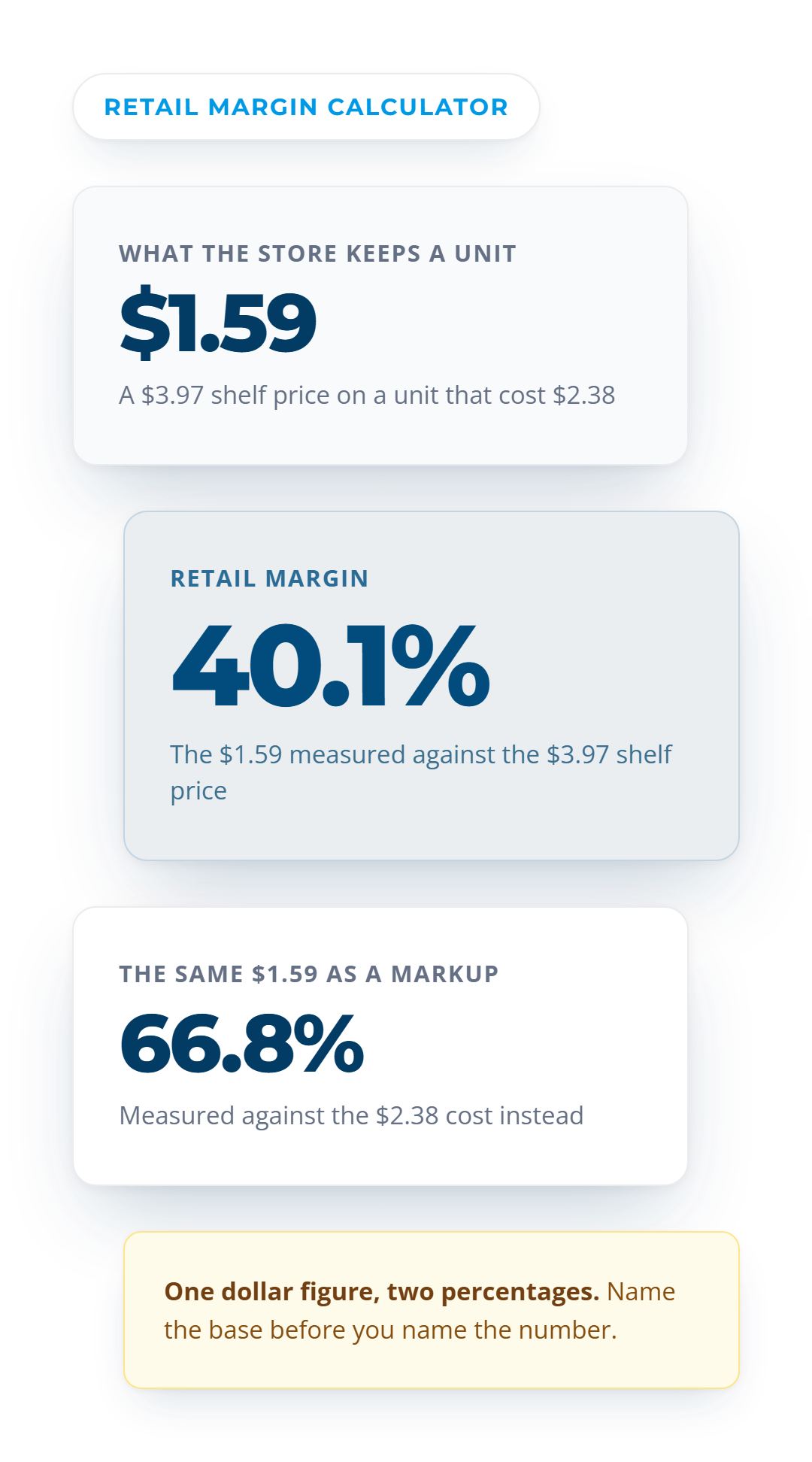
Retail margin
40.1%
$1.59 of the $3.97 shelf price
The same thing as a markup
66.8%
Markup is measured on cost, margin on the shelf price
Gross profit per unit
$1.59
$3.97 less the $2.38 cost
Shelf price for a 40% margin
$3.97
What the target needs, against $3.97 today
Gross profit per case
$19.08
$1.59 across 12 units
Monthly gross profit
$9,540
At 500 cases a month
A 40.1% retail margin is a 66.8% markup, not a 40% one. That gap is the whole reason to calculate retail margin on the shelf price rather than the cost: ask a buyer for "40%" and you will each mean a different number, about $0.64 a unit apart.
Margins slip when the price list and the order guide disagree. VoiceOrder Solutions keeps order guides and prices current, so the case that ships is the case that was quoted.
Book A Demo →
Estimates only. This is the gross margin on the unit and does not carry shrink, promotions or the cost of the space it sits in.
40.1%

Retail margin on a $3.97 unit costing $2.38

66.8%

The same $1.59 measured against cost instead

$0.64

A unit apart if 40% means markup, not margin

Sound Familiar?

Margin and markup are not the same number, and buyers use both

Every category review turns on one percentage. Half the room measures it against cost and half against the shelf price.
Target icon

The buyer asked for 40%, so we built it at a 40% markup.

A 40% markup shelves the unit at $3.33 and keeps $0.95. A 40% margin needs $3.97 and keeps $1.59. The gap is $0.64 a unit, $7.68 a case, $3,840 a month at 500 cases.
Rising trend line icon

They gave us the margin they need, not the price.

Run it backwards. A $2.38 unit at a 40% margin has to shelve at $3.97, and at a 50% margin it has to shelve at $4.76. The calculator solves for the price, not just the percentage.
Cash icon

The margin we quoted stopped being true.

A margin holds only while both numbers hold. A $28.56 case shelving at $47.64 leaves the store $19.08, and a stale price on either side moves that before anyone checks.
How It Works

How to use the retail margin calculator

Two numbers get you the margin. The other three turn it into a case and a month.
1

Enter the unit cost and the shelf price

A $2.38 unit ringing up at $3.97 keeps $1.59. That is a 40.1% retail margin, and the same $1.59 is a 66.8% markup.
2

Set the margin you are aiming at

At 40% the unit has to shelve at $3.97. Move the target to 50% and it has to shelve at $4.76. The card label follows whatever you type.
3

Add the pack and the monthly cases

12 units a case turns $1.59 into $19.08, and 500 cases a month makes it $9,540. Both come off the settled $1.59, so the cards reconcile.
What You See

What the calculator shows you

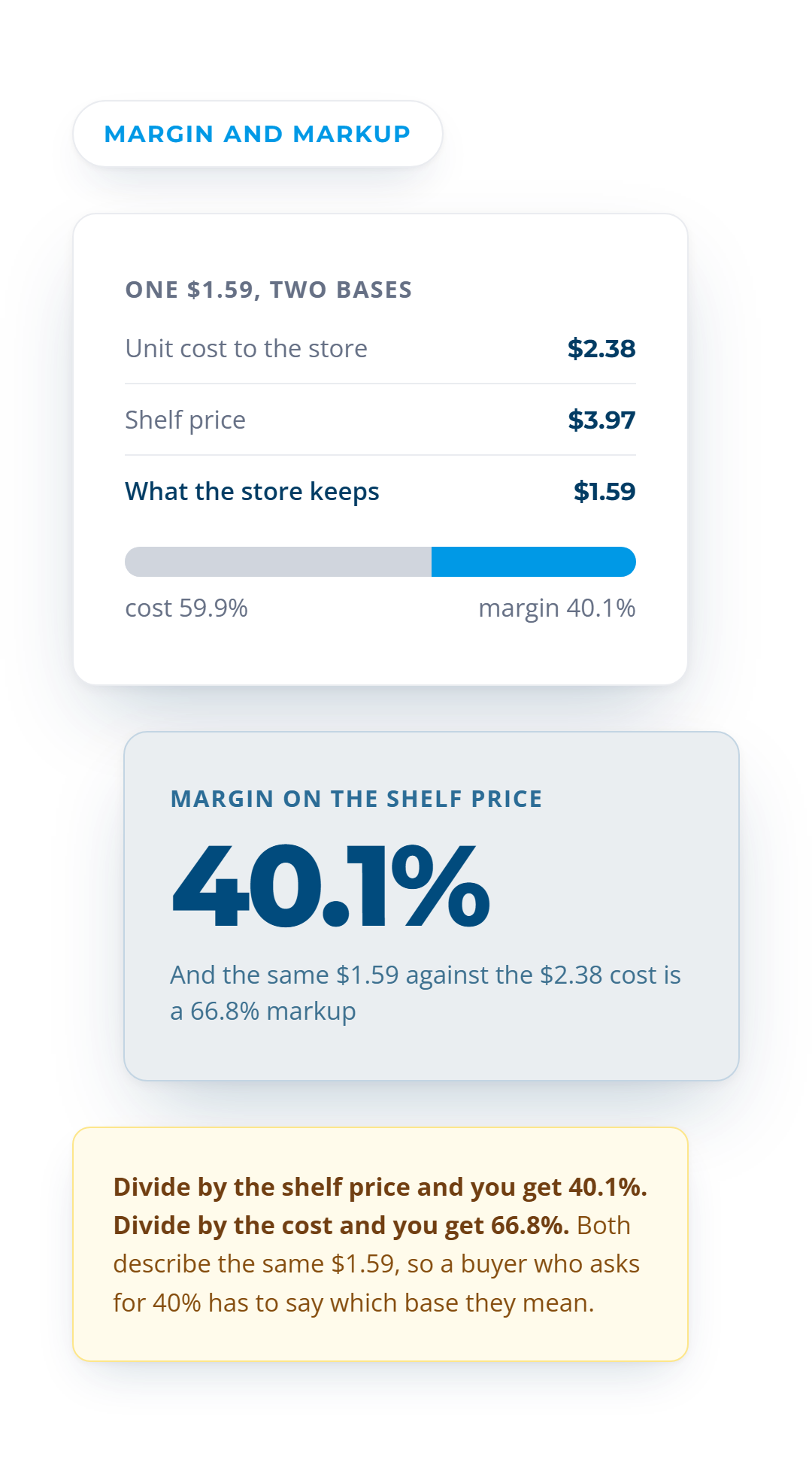
A $3.97 shelf price split into $2.38 of cost and $1.59 of margin, reading 40.1 percent on the shelf and 66.8 percent on cost
Margin and markup

The margin, and the markup that means the same money

$1.59 against a $3.97 shelf price is a 40.1% margin. The same $1.59 against a $2.38 cost is a 66.8% markup. One dollar figure, two percentages, and the card shows both.
Both percentages side by side
Margin measured on the shelf price
Markup measured on cost
Names the dollars behind both
Target margin solver

The shelf price a target margin actually needs

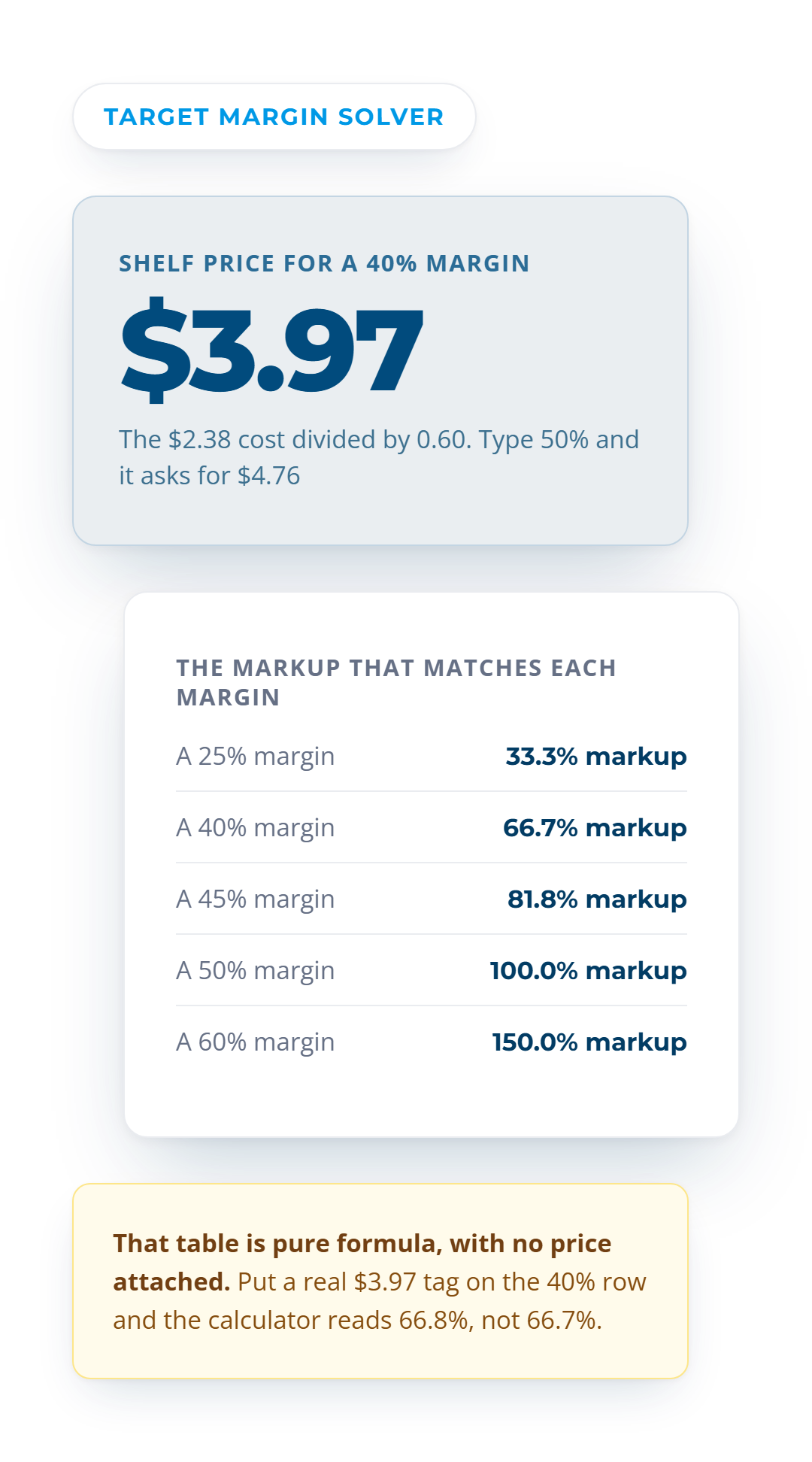
Type 40% and the calculator asks for $3.97. Type 50% and it asks for $4.76. It also says how far that sits above or below the price today.
Solves the price from a margin
Slider or typed percentage
Labels the card with your target
Will not promise a 100% margin
The $3.97 shelf price a 40 percent margin needs, beside the markup that matches each margin from 25 to 60 percent
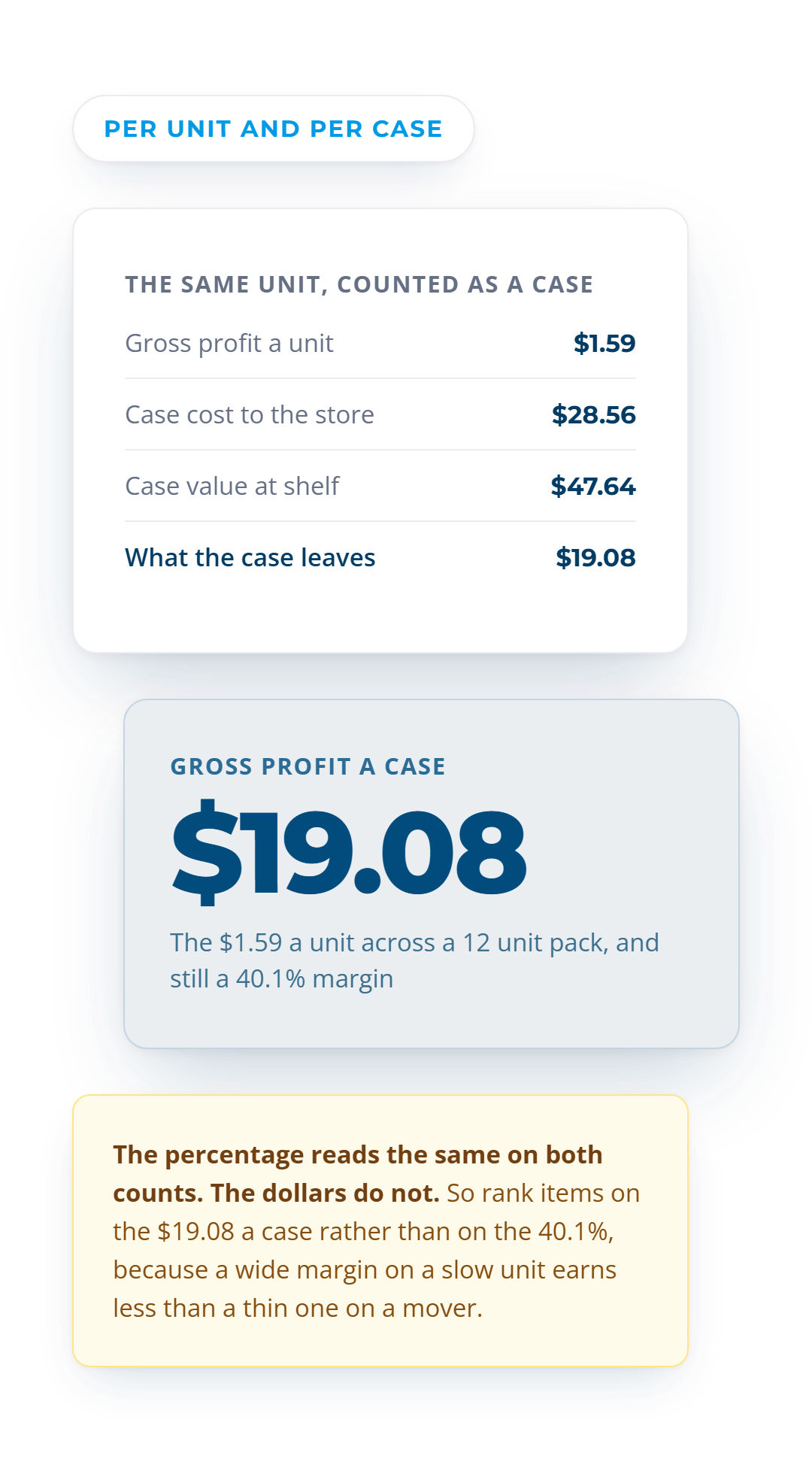
The same $1.59 a unit scaled to a 12 pack, giving $19.08 of gross profit a case at the same 40.1 percent margin
Per unit and per case

The same margin in units, cases and dollars

$1.59 a unit across 12 units is $19.08 a case. A $28.56 case shelving at $47.64 leaves exactly that $19.08, which is the point of settling to cents first.
Converts units into cases
Uses your own pack size
Settles to whole cents first
Cards subtract to each other
Monthly dollars

What the item is worth across a month

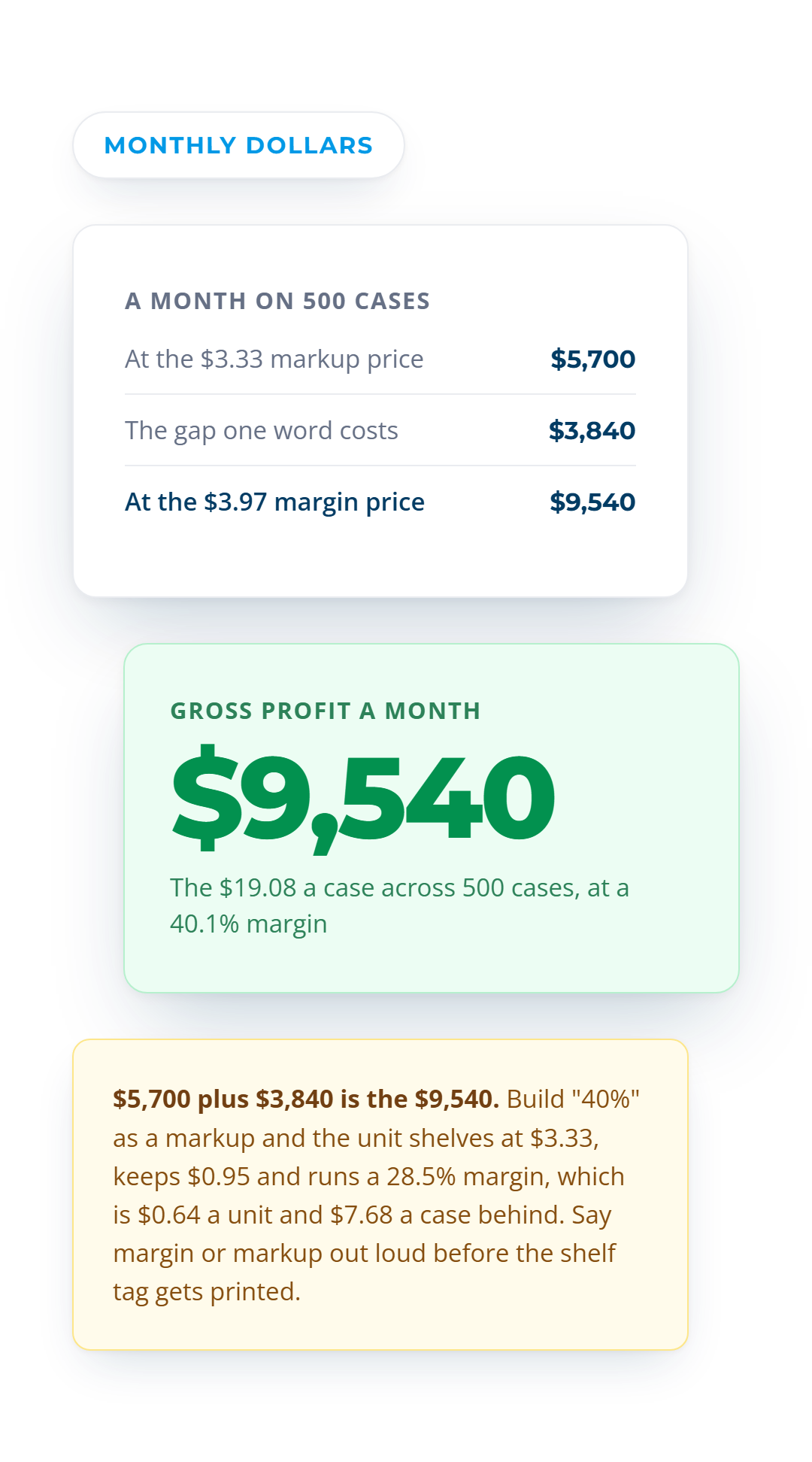
At 500 cases a month that $19.08 is $9,540 of gross profit. Price the same unit off a 40% markup instead and the month is $5,700.
Scales to your case count
Turns red when the price is under cost
Totals reconcile to the per case math
One figure for a category review
A month priced both ways, $5,700 off a 40 percent markup against $9,540 off a 40 percent margin, a $3,840 gap
After The Numbers

What to do once you know the margin

A margin number earns its keep when it changes what you quote, what you suggest and what you check next month.
Percent sign icon

Say margin or markup out loud

Price tag icon

Quote the shelf price, not the percentage

Product case icon

Check the pack before the percentage

Comparison bars icon

Rank items by dollars a case

Falling trend line icon

Look at the thin units first

Stock buffer level icon

Leave room for shrink

Verified checkmark icon

Hold one number across reps

Turnover cycle arrows icon

Rerun it after a cost move

Order guide list icon

Keep the order guide current

Six Levers

What actually decides the margin on a unit

Only the first two sit inside the percentage. The other four are why the percentage moves after you quote it.
Balance scale icon

Which base you measure on

Cost or shelf price. $1.59 is a 66.8% markup on cost and a 40.1% margin on the shelf. Name the base before you name the number.
Stacked cases icon

The pack size

12 units a case turns $1.59 into $19.08. Change the pack and every per unit figure moves, so compare items on the same base.
Dollar sign icon

Where the cost lands

The store's cost is your case price split out, $28.56 across 12 units here. Freight, a split case or a short delivery changes it before margin does.
Shrink and spoilage icon

Shrink and spoilage

40.1% is the gross margin on units that scan. Whatever gets thrown out comes off it, which is why fresh categories are quoted higher.
Calendar icon

Promotions

A temporary shelf price of $3.33 is a 28.5% margin, not 40.1%. Price the promotion on its own and know what the week costs.
Invoice document icon

Whether the price is current

A margin is only as good as the price on the order. Any gap between what you quoted and what the order guide carries shows up here first.

See how VOS keeps the quoted price on every order

VoiceOrder Solutions builds each customer a personalized order guide from your own SKUs and pricing, so the price behind the margin is the price they order against.
The Comparison

Three ways to answer a buyer who asks for 40%, and which one holds up

Same $2.38 unit, same $3.97 shelf price, same 12 units a case. These are the three answers that actually get given in a category review.

What you need when a buyer asks for a margin

Cost and shelf price, margin and markup together

A markup percentage on cost

A rule of thumb for the category

Says what the store actually keeps
No, 66.8% on cost is 40.1% on the shelf
No
Names the base it measures on
Only if someone says so out loud
No, a band has no base
Solves the price a target margin needs
No, it starts from the answer
No
Turns a unit back into a case
Yes
No
Scales to a month of movement
Yes, once you add a case count
No
Catches a shelf price under cost
Yes, a price under cost is obvious
No, it never sees the cost
Survives a change of pack size
Yes
No, it ignores the pack entirely
Means the same thing to both sides
No, this is where the $0.64 gap starts
Only until one side checks the math
Where it falls down
It is gross margin, so shrink and promotions sit outside it
A 40% markup shelves at $3.33, a 28.5% margin
A 25% to 45% band is not a shelf price
Best used for
Quoting a shelf price and defending the margin behind it
Setting a price from a cost you control
A sanity check before the review, nothing past that
FAQ

Common questions about retail margin

How do you calculate retail margin?
Subtract the cost from the shelf price, then divide by the shelf price. A $3.97 unit costing $2.38 keeps $1.59, and $1.59 divided by $3.97 is 40.1%. It reads 40.1% rather than 40.0% because an exact 40% needs $3.9667, and a real shelf tag settles that to $3.97.
Is 50% margin the same as 100% markup?
Yes, and it is the one place the two numbers meet. A 50% margin means half the shelf price is profit, so the profit equals the cost. On a $2.38 unit the price has to be $4.76, which keeps $2.38, and $2.38 on a $2.38 cost is a 100% markup. Above 50% margin the markup climbs much faster.
What markup do I need for a 60% margin?
A 150% markup. Divide 1 by 1 minus the margin and subtract 1, which turns 60% into 150%. On a $2.38 unit that is a $5.95 shelf price keeping $3.57, and $3.57 divided by $5.95 comes back to 60%. Set the target in the calculator and it prints the price for you.
What is a good retail markup percentage?
Most grocery categories run a 25% to 45% retail margin, which is a 33.3% to 81.8% markup on cost. Dry grocery sits at the bottom of that band and fresh or specialty sits at the top, because shrink eats into it. Quote the band for the category, then the dollars a case behind it.
Is a 50% profit margin too much?
It is high for grocery and normal in other categories. A 50% margin doubles the cost, so a $2.38 unit shelves at $4.76 instead of $3.97. Shoppers price-check against the next store, so that level usually holds only on specialty, prepared or slow-moving lines where nobody carries a reference price.
What is contribution margin, and how is it calculated?
Contribution margin is the price less the variable cost of selling one more unit. On this item the only variable cost is the $2.38, so contribution and gross profit are the same $1.59 a unit, or $19.08 a case. They separate once delivery, shrink or a promotion is counted, and none of those sit inside the 40.1%.
What is a good profit margin for a food distributor?
Gross and net are different questions, and this calculator answers neither for you. The 40.1% here is the store's gross margin on one unit. Judge an item on the dollars it earns, $19.08 a case and $9,540 a month at 500 cases, because a wide percentage on a slow unit is worth less than a thin one on a mover.

Hold the margin you quoted on every order

VoiceOrder Solutions builds each account a personalized order guide from your own SKUs and pricing, and every order arrives digitized and confirmed, so the price behind the margin is the price that gets ordered.