For Independent Food Distributors

Product Markup Calculator

Put in one case cost and see the price and the margin at every markup rung, plus the markup your target margin actually needs.
VoiceOrder app ordering screen

Product Markup Calculator

The formula to calculate markup percentage runs on cost. Margin runs on the selling price. Put in one case cost to see what each markup on the ladder actually keeps, and the markup a target margin really needs.

The case you are pricing

$
Your landed unit cost for one case. Every price on the ladder is this cost times one plus the markup, which is how to calculate selling price using markup percentage.
cases
How many cases of this product move in a month across the order guide.

The margin you need to keep

%
The share of the selling price you need to keep. Set it and the solver returns the markup price that hits it.
Markup for a 30% margin
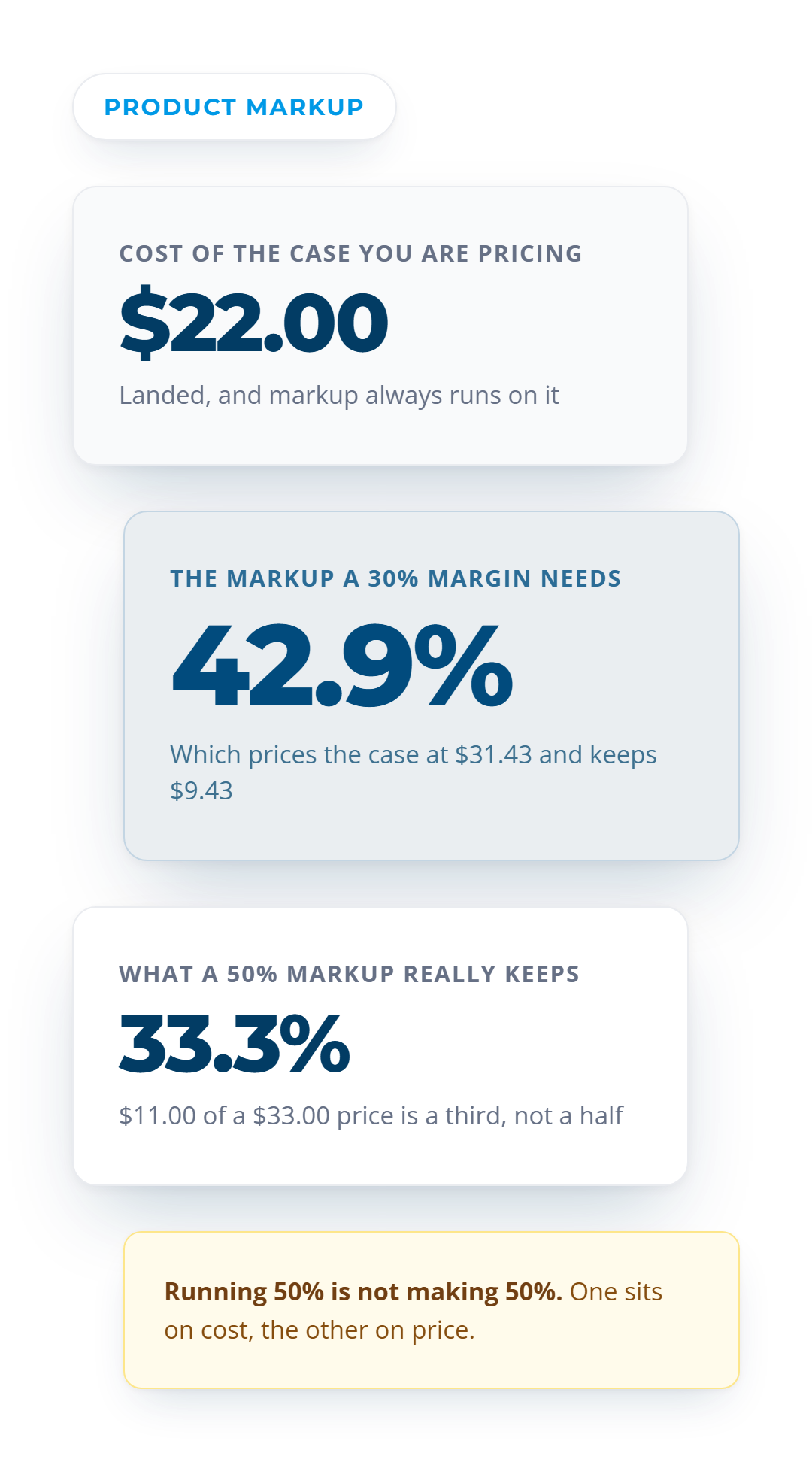
42.9%
A 30% margin always needs a bigger markup than 30%
Price at that markup
$31.43
$22.00 divided by 0.70, which leaves the 30% margin
Gross profit per case
$9.43
$31.43 less the $22.00 cost
Monthly gross profit
$56,580
At 6,000 cases a month
At a 20% markup
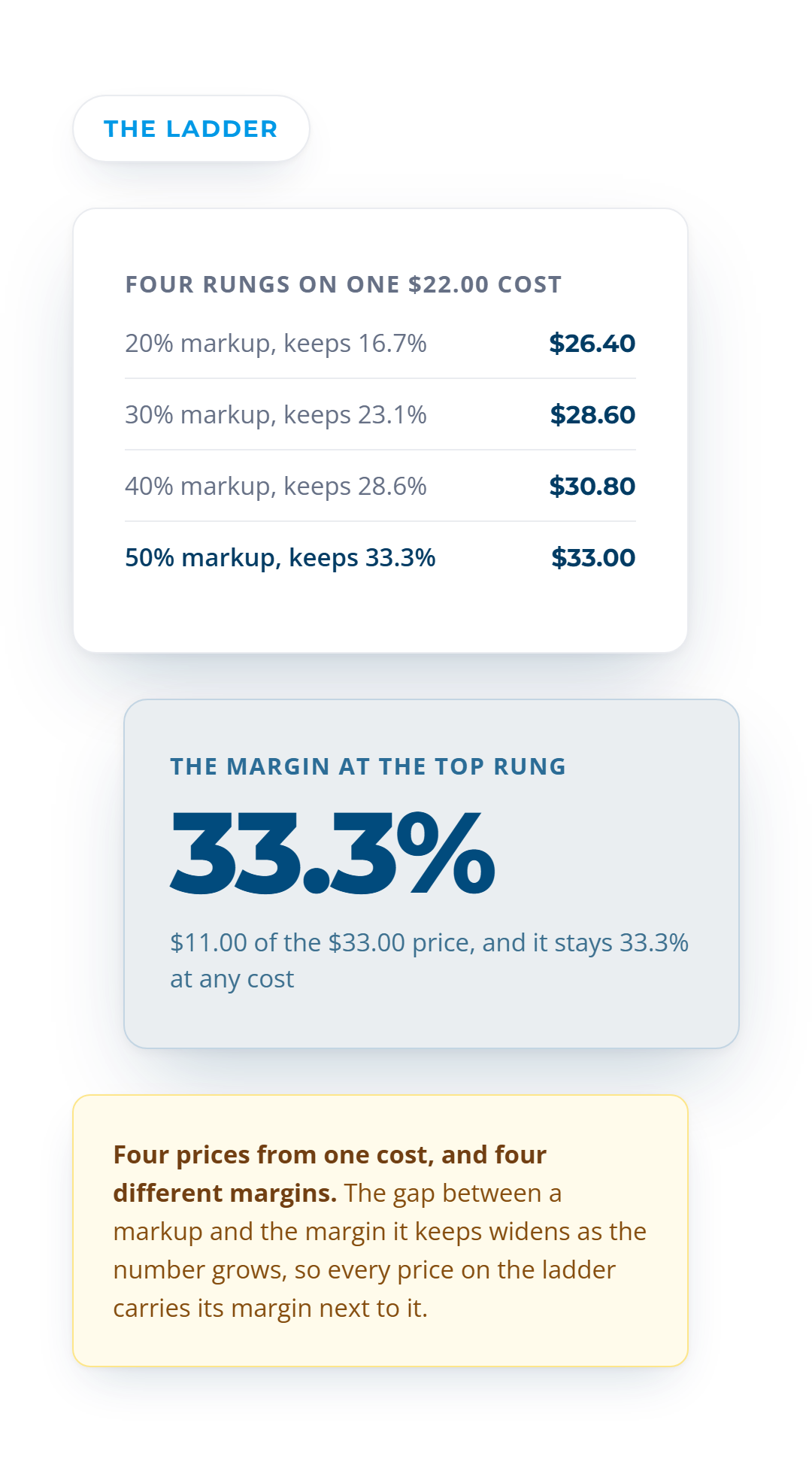
$26.40
16.7% margin, $4.40 a case
At a 30% markup
$28.60
23.1% margin, $6.60 a case
At a 40% markup
$30.80
28.6% margin, $8.80 a case
At a 50% markup
$33.00
33.3% margin, $11.00 a case
Every markup on the ladder reads higher than the margin it produces. A 50% markup is a 33.3% margin, so "we run 50%" and "we make 50%" are different sentences. Holding a 30% margin takes a 42.9% markup.
A markup only holds if the price the order was placed against is the current one. VoiceOrder Solutions gives every account an order guide tied to your own pricing and SKUs, so last quarter's price never prices a case under the markup you set.
Book A Demo →
Estimates only. The formula to calculate markup price is cost divided by one minus the target margin. Asking how to calculate markup on selling price is the usual wrong turn, because markup is always measured on cost.
42.9%

The markup a 30% margin actually needs

33.3%

What a 50% markup really keeps on a $22.00 case

$56,580

Monthly gross profit across 6,000 cases

Sound Familiar?

A markup number and a margin number are never the same number

The arithmetic is one line. Which base it runs on, your cost or your selling price, is the part that gets lost on a quote.
Rising trend line for a markup quoted as 50 percent

We run 50% on that line.

A 50% markup prices the $22.00 case at $33.00 and keeps $11.00, which is a 33.3% margin. Running 50% and making 50% are two different numbers.
Balance scale weighing a markup number against a margin number

The buyer asked us for 40%.

A 40% markup puts the case at $30.80 and keeps 28.6%. If the 40% they meant was margin, the price has to be $36.67, which is $5.87 a case apart.
Cycle arrows for one target repeated on every line

Thirty percent is our number, every line.

A 30% markup keeps 23.1%, so a 30% target set in markup lands 6.9 points short. The same target set in margin needs a 42.9% markup.
How It Works

How to use the product markup calculator

One cost sets the whole ladder. A target margin turns the question around and hands you the markup it takes.
1

Enter the cost of the case you are pricing

Markup is always measured on cost, so use the $22.00 you really pay landed. Every rung on the ladder is that cost times one plus the markup.
2

Read the ladder from cost to price to margin

A 20% markup is $26.40 and a 16.7% margin. A 50% markup is $33.00 and a 33.3% margin. Same cost, four answers.
3

Set the margin you need and read the markup back

A 30% margin takes a 42.9% markup, which prices the case at $31.43 and keeps $9.43. Move the target and the markup moves with it.
What You See

What the calculator shows you

A markup ladder on one $22.00 case cost: a 20% markup prices the case at $26.40 and keeps a 16.7% margin, 30% at $28.60 keeps 23.1%, 40% at $30.80 keeps 28.6%, and 50% at $33.00 keeps 33.3%.
The ladder

Price and margin at every markup rung

One $22.00 cost prices at $26.40, $28.60, $30.80 and $33.00 across the four rungs, with the margin each one keeps printed under the price.
Four rungs from a single cost
Margin printed beside every price
Settles each price to whole cents
Profit per case on every rung
The solver

The markup a target margin needs

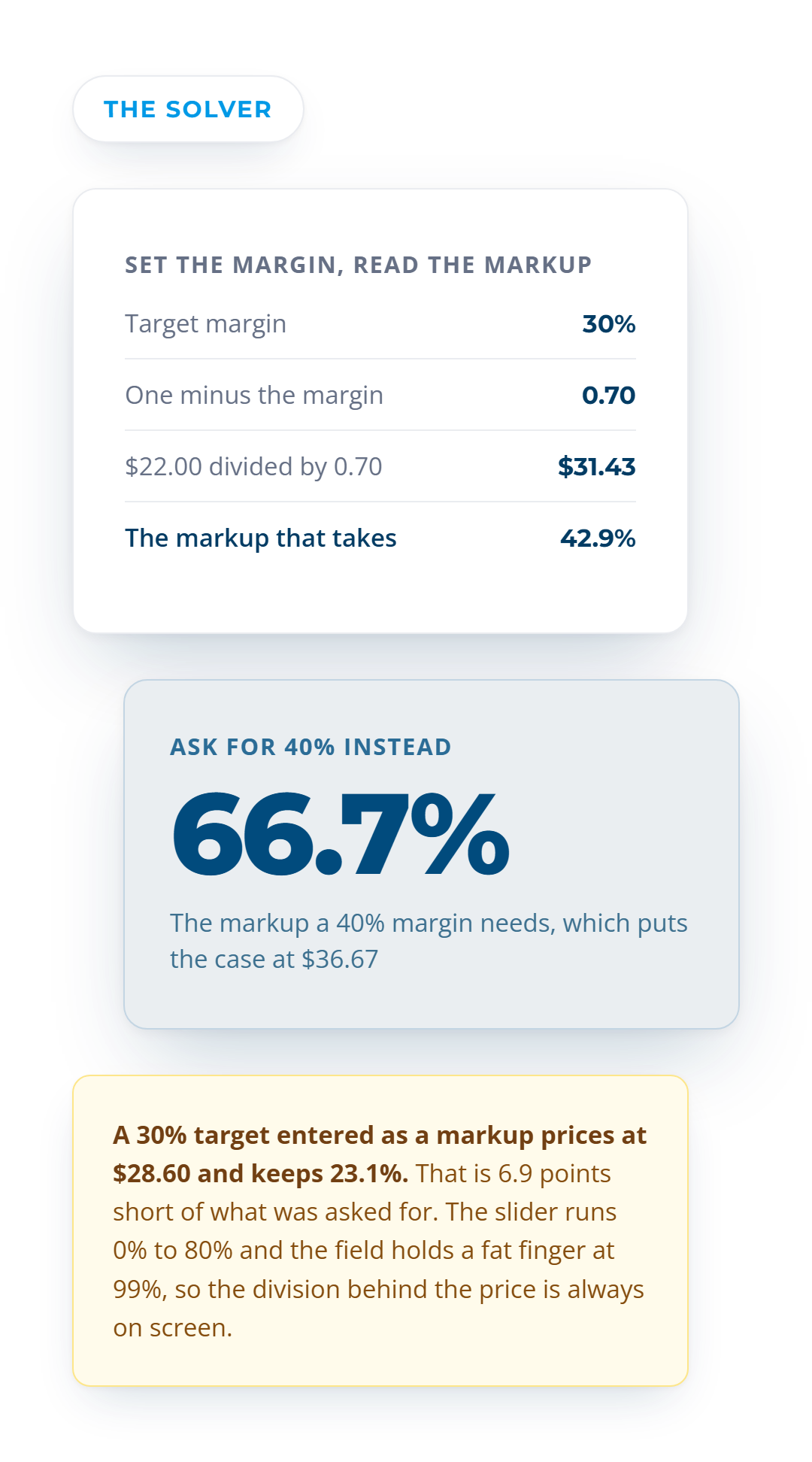
A 30% margin needs a 42.9% markup, not a 30% one. The price is $31.43 and the $9.43 it keeps is exactly 30% of that price.
Slider from 0% to 80%
Holds a fat finger at 99%
Shows the division behind the price
Recalculates as you type
A solver showing that a 30% target margin needs a 42.9% markup, dividing the $22.00 case cost by 0.70 to price at $31.43, and that asking for 40% instead needs a 66.7% markup and a $36.67 case.
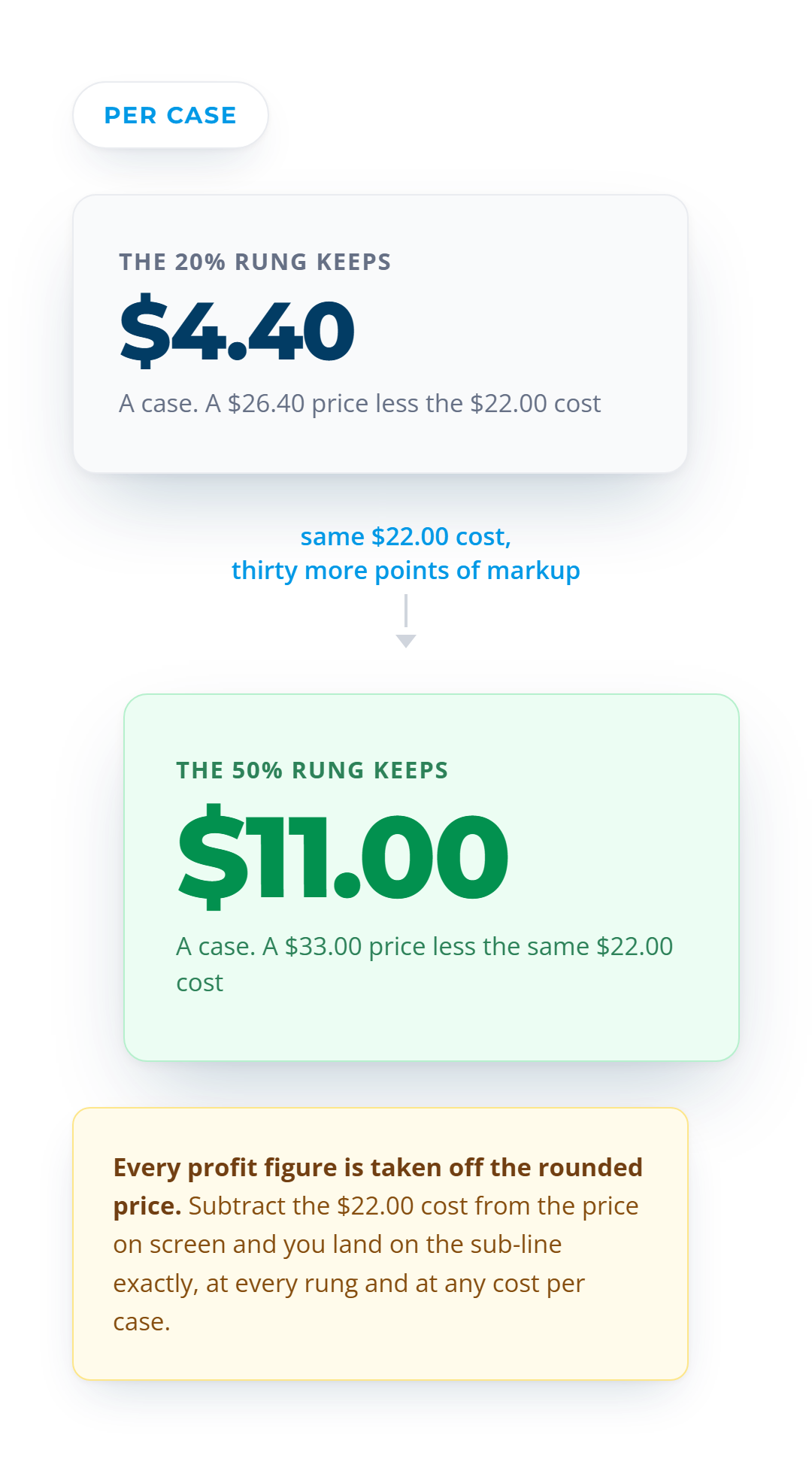
Two cards comparing profit on one case at the same $22.00 cost: the 20% rung keeps $4.40 off a $26.40 price, and the 50% rung keeps $11.00 off a $33.00 price, thirty points of markup apart.
Per case

What a rung is worth on one case

The 20% rung keeps $4.40 a case and the 50% rung keeps $11.00. Subtract the $22.00 cost from the price on screen and you land on the sub-line exactly.
Profit taken off the rounded price
Cards reconcile by subtraction
Works at any cost per case
Reads "--" instead of guessing at a zero cost
Per month

What the markup is worth across a month

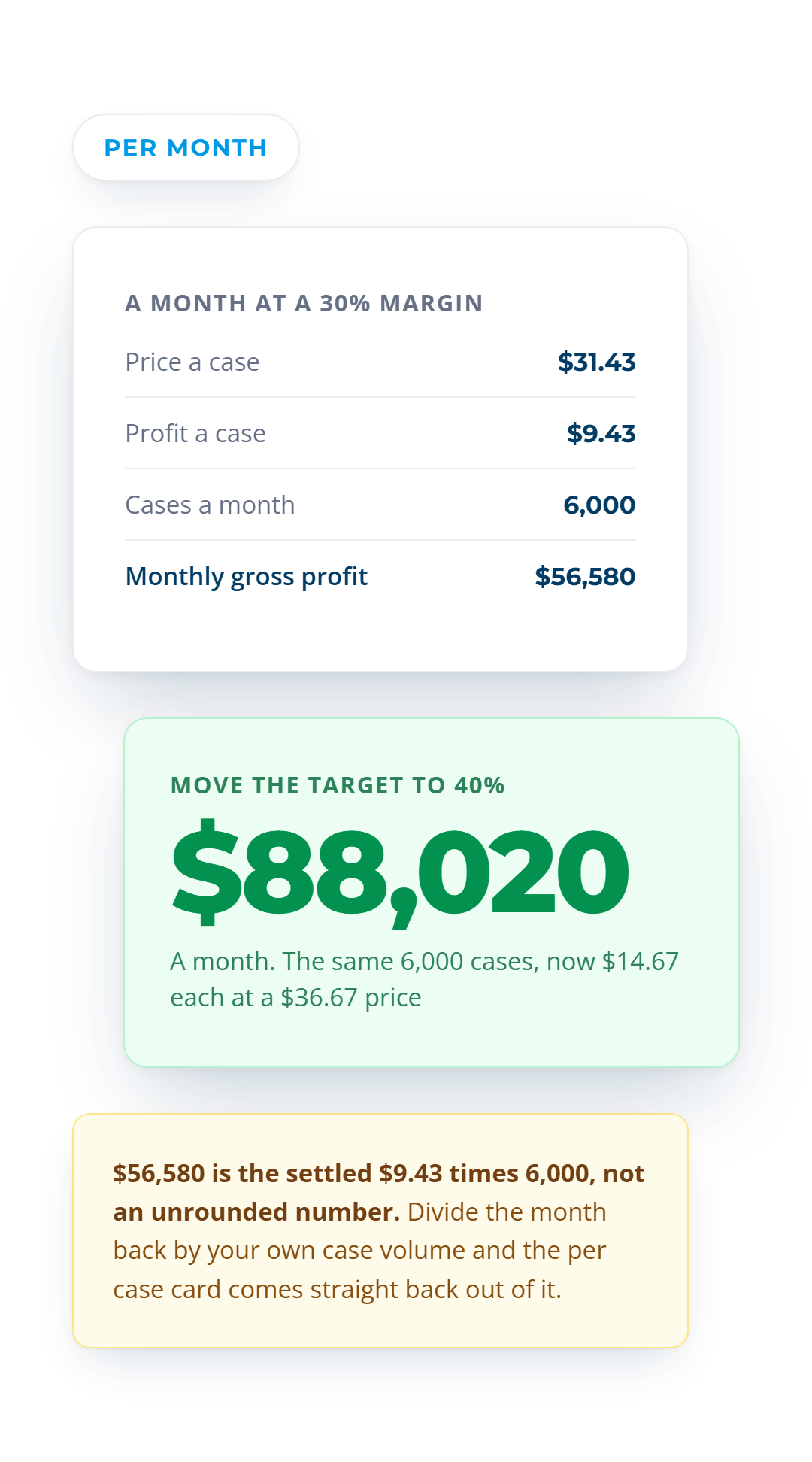
$9.43 a case across 6,000 cases is $56,580 of monthly gross profit. Move the target margin to 40% and the same volume is $88,020.
Multiplies the settled per-case profit
Takes your own case volume
Rounds the month to whole dollars
Moves with the target margin
A month at a 30% target margin: a $31.43 case price keeps $9.43, which across 6,000 cases a month is $56,580 of gross profit, rising to $88,020 once the target moves to 40%.
After The Numbers

What to do once you know the markup

A markup is only worth the price list it reaches. These nine habits are what keep the ladder honest.
Delivery truck for the freight inside landed cost

Mark up landed cost, not list

Percent sign for naming markup or margin out loud

Say markup or margin out loud

Target for the margin you set out to hit

Set the target in margin

Comparison bars for checking which markup rung a line sits on

Check which rung each line sits on

Price tag for repricing a case when the cost moves

Reprice when the cost moves

Order guide list for one current guide per account

Keep one current guide per account

Falling trend line for thin margins on staple cases

Watch the thin staples

Dollar sign for quoting a case price instead of a percentage

Quote a case price, not a percentage

Calendar for a quarterly review of the markup ladder

Review the ladder quarterly

Six Levers

What actually decides the margin a markup leaves you

Five of these six decide the margin a markup leaves you. The other one decides whether that margin is worth having.
Case of product for the cost a markup runs on

The base you mark up

Markup runs on cost and margin runs on price. A 50% markup on $22.00 is $33.00, and the 33.3% margin is measured on that $33.00.
Invoice for the costs already inside the case price

What the cost already includes

The ladder can only mark up the number you type. Leave freight out of the $22.00 and all four rungs price the case short by the same gap.
Check mark for confirming which number the buyer means

Which number the buyer means

Asked for 40%, a buyer may mean the $30.80 markup price or the $36.67 margin price. That is $5.87 a case, so ask which one.
Cash for the money a margin target actually keeps

Targets written in margin

A 30% target entered as a markup prices at $28.60 and keeps 23.1%, which is 6.9 points short of what was asked for.
Rising chart for the case volume behind a markup rung

The volume behind the rung

$6.60 a case across 6,000 cases beats $11.00 a case on a line nobody orders. Price the ladder, then look at what actually moves.
Clock for how current the cost you mark up is

How current the cost is

A 42.9% markup on last quarter's cost is not a 30% margin. The ladder is exactly as current as the cost you feed it.

See how VOS gets a new price onto the next order

VoiceOrder Solutions automates order intake, so no rep re-keys a phone order, and it captures orders placed after hours. A repriced case is then live on the next order, not waiting on a callback.
The Comparison

Three ways to put a price on a case, and which one holds up

Same $22.00 cost, same 6,000 cases a month. These are the three ways the price actually gets set.

What you need before you quote a case

A markup ladder with the margin beside it

One markup across the whole guide

Whatever percentage the buyer asks for

Names the price at every markup rung
Only at the one rung you picked
No, the number arrives from outside your cost
Shows the margin each markup keeps
No, the margin never gets written down
No, and nobody asks which one was meant
Turns a target margin into a markup
No, it only runs the other way
No
Settles every price to whole cents
Yes, the arithmetic is the same
Yes, once somebody works the price out
Shows the profit on one case
Yes, cost times the markup
No, not unless you price it twice
Shows the month at your own volume
No, not without a case volume
No
Works at any cost per case
Yes
Yes, a buyer does not care what it cost you
Survives a cost increase
The markup holds and the margin slips quietly
No, a cost increase stays your problem
Where it falls down
It marks up the cost you type, so a cost missing freight prices all four rungs short
One rung across staples and specialty leaves money on both
A 40% markup and a 40% margin are $5.87 a case apart
Best used for
Setting a case price on a line where the margin has to be defended
A fast quote on a line nobody argues about
An account you have already decided to keep
FAQ

Common questions about product markup

How do you calculate markup on a product?
Take the price, subtract the cost, then divide by the cost. A $22.00 case sold at $33.00 keeps $11.00, so the markup is 50%. Divide the same $11.00 by the $33.00 price and you get a 33.3% margin, which is what your P&L reports.
Is it better to use markup or margin?
Set the target in margin, then price in markup. Margin is the share of the price you keep, so 30% of a $31.43 case is $9.43. Type the margin you need and the calculator prints the markup, 42.9% here, so nobody converts by hand.
What does 5% markup mean?
It means the price is the cost plus 5% of the cost. On a $22.00 case that adds $1.10, so the price is $23.10 and the margin is 4.8%. Five points of markup is always under five points of margin, and on food it will not cover shrink.
What is a 40% markup on $100?
The price is $140.00. The markup adds $40.00 to the $100.00 cost, and that $40.00 is a 28.6% margin on the $140.00 price. Type a $100.00 cost into the calculator and the 40% rung reads exactly that.
What margin does a 20% markup leave?
16.7%, and it does not matter what the case cost. A $22.00 case at a 20% markup prices at $26.40 and keeps $4.40, which is 16.7% of $26.40. Type a $500.00 cost and the same rung prices at $600.00 and keeps $100.00, still 16.7%.
Is 30% a good markup?
On a $22.00 case a 30% markup prices at $28.60 and keeps 23.1%, which is thin once shrink and delivery come out of it. Name the margin you need first, then read the markup off the ladder. A 30% margin on that case takes 42.9%.
How do you work out a selling price from a markup?
Multiply the cost by one plus the markup. A $22.00 case at a 40% markup is $30.80, and at a 50% markup it is $33.00. Going the other way, divide the cost by one minus the margin, so $22.00 divided by 0.70 gives $31.43.

Keep the markup on the price the order is placed against

VoiceOrder Solutions builds each account an order guide tied to your own pricing and SKUs, so a $22.00 case is not ordered at last quarter's price under a markup you have already moved.