For Independent Food Distributors

Price Change Calculator

See what a price move does to your margin, your profit per case, and how much volume you can afford to lose before you are worse off.
VoiceOrder app ordering screen

Price Change Calculator

Before you move a price, see the new margin, the profit swing per case, and how much volume you can lose or must gain to come out ahead.

Today's price

$
What you charge for the case now.
$
Landed cost, so we can track the margin.

The change

%
A raise is positive, a cut is negative.
cases
Today's volume, before the change.
New price per case
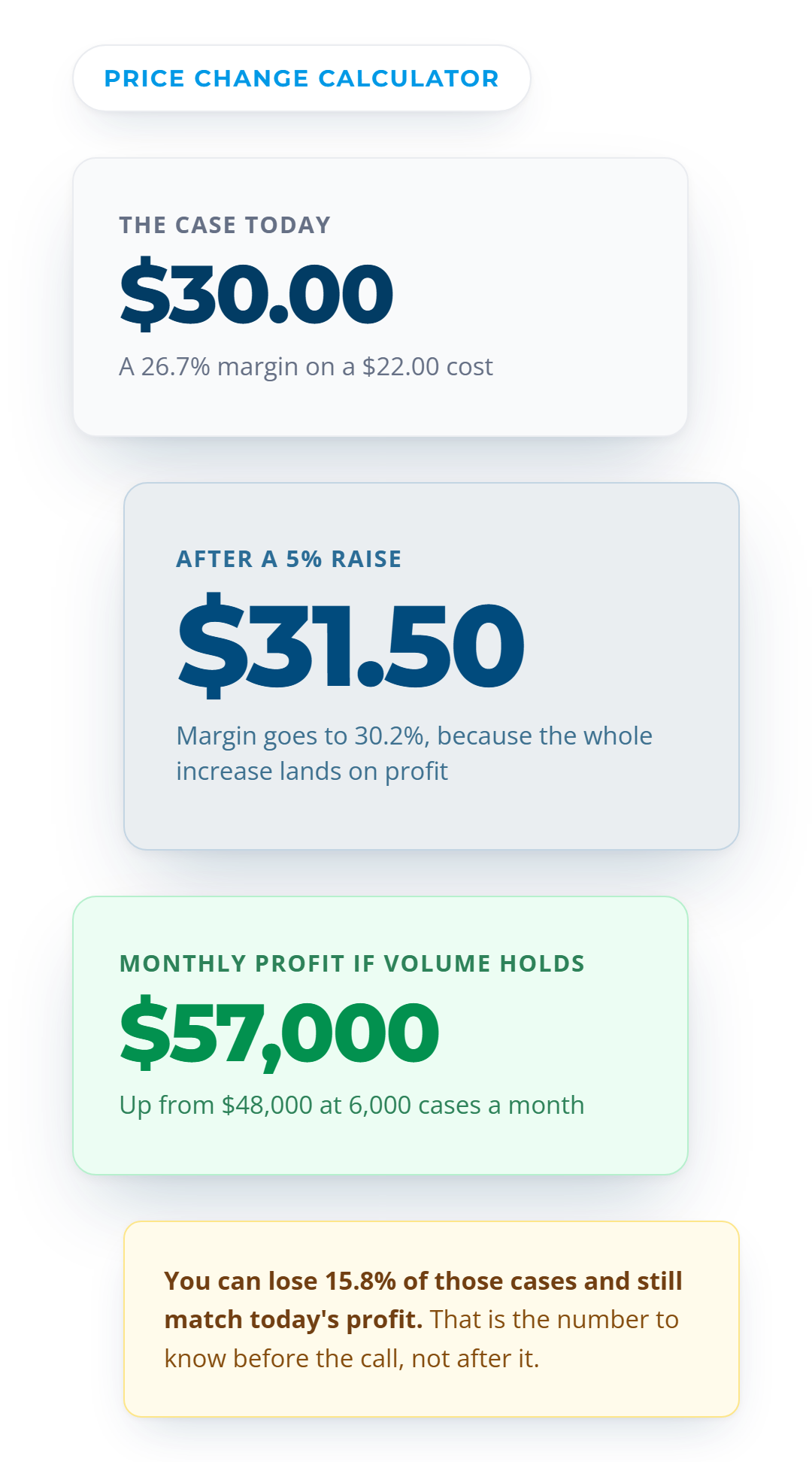
$31.50
A 5.0% increase from $30.00
New gross margin
30.2%
Was 26.7%
Profit change per case
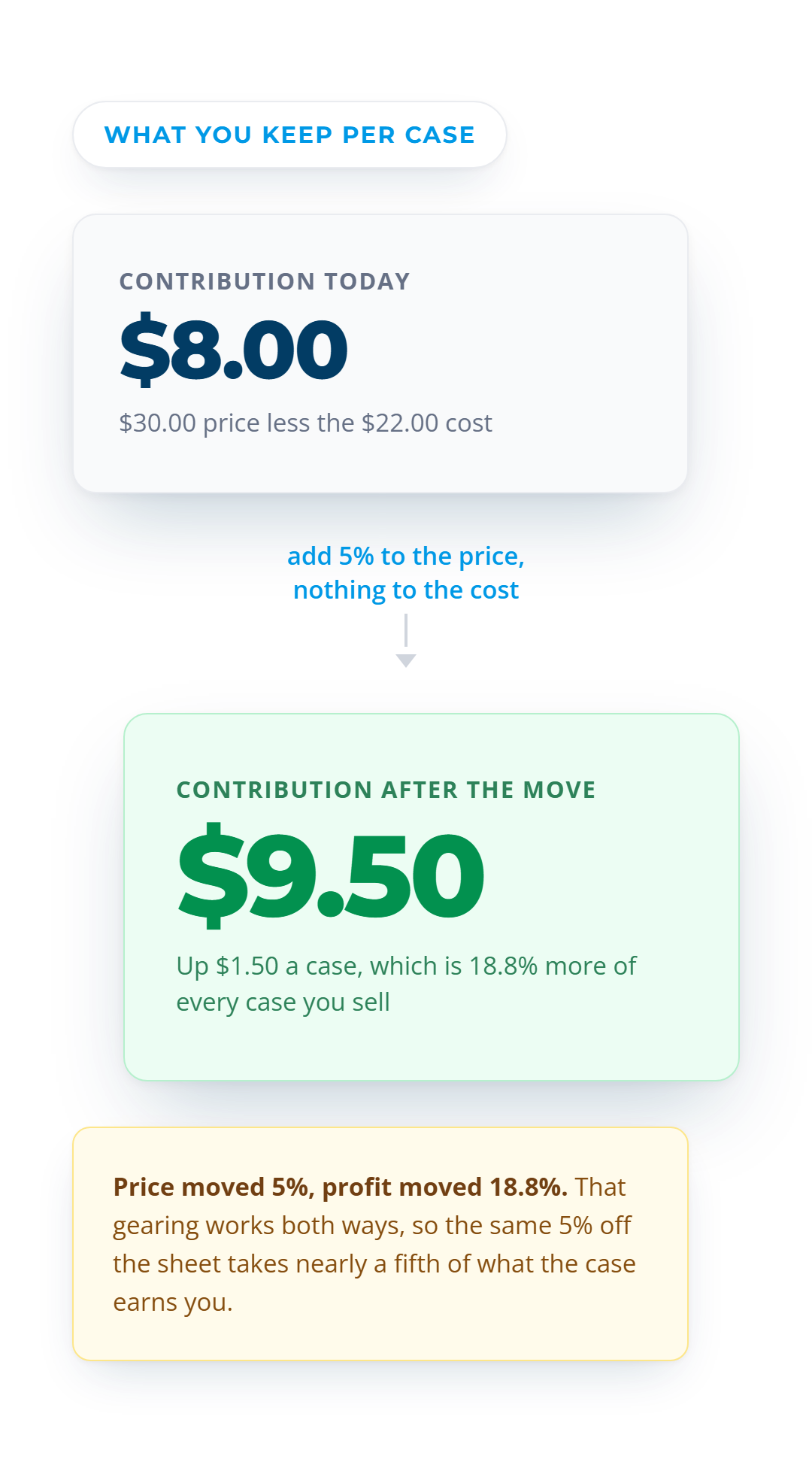
+$1.50
$8.00 to $9.50 per case
Breakeven volume shift
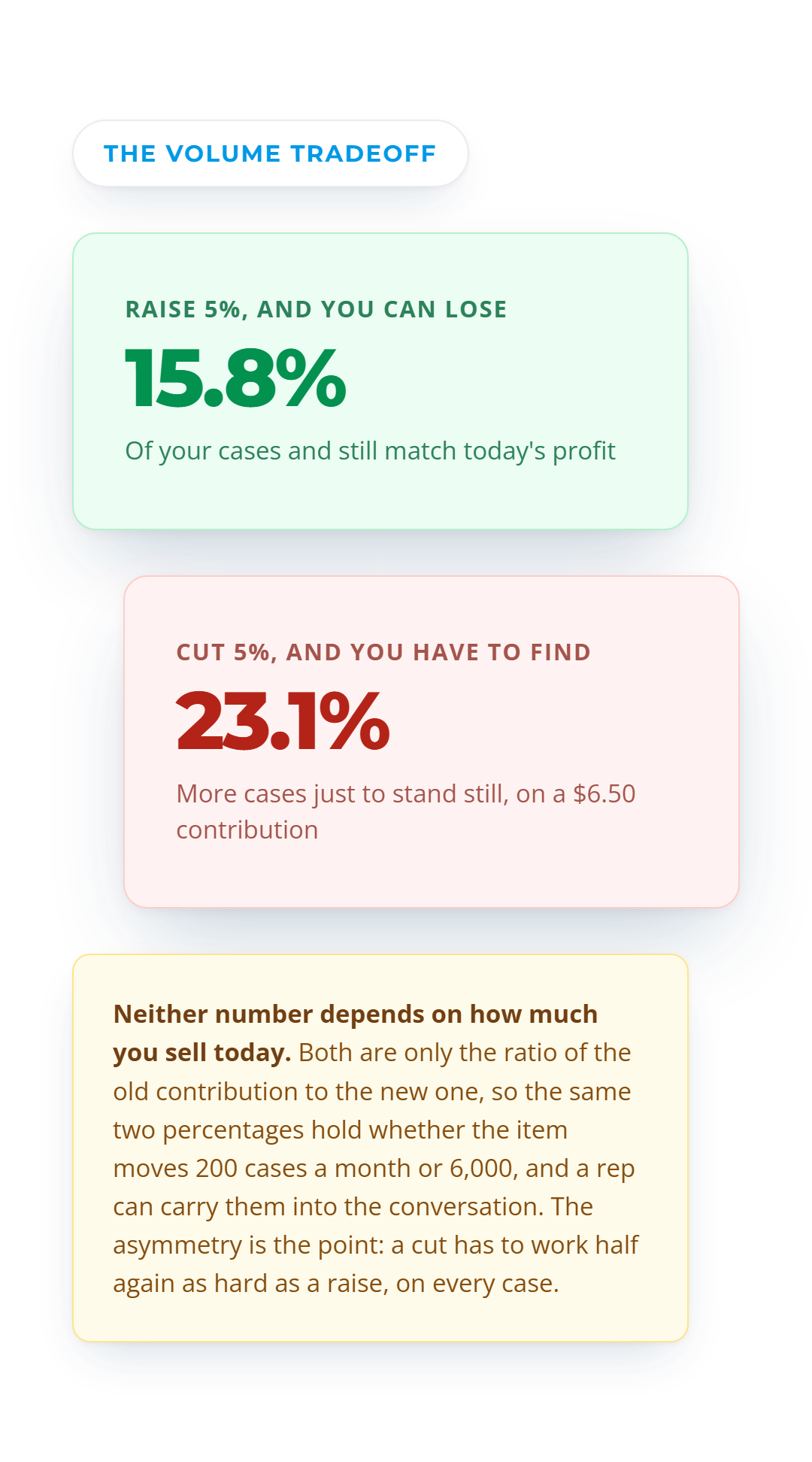
15.8%
Volume you can lose and still match profit
Monthly profit if volume holds
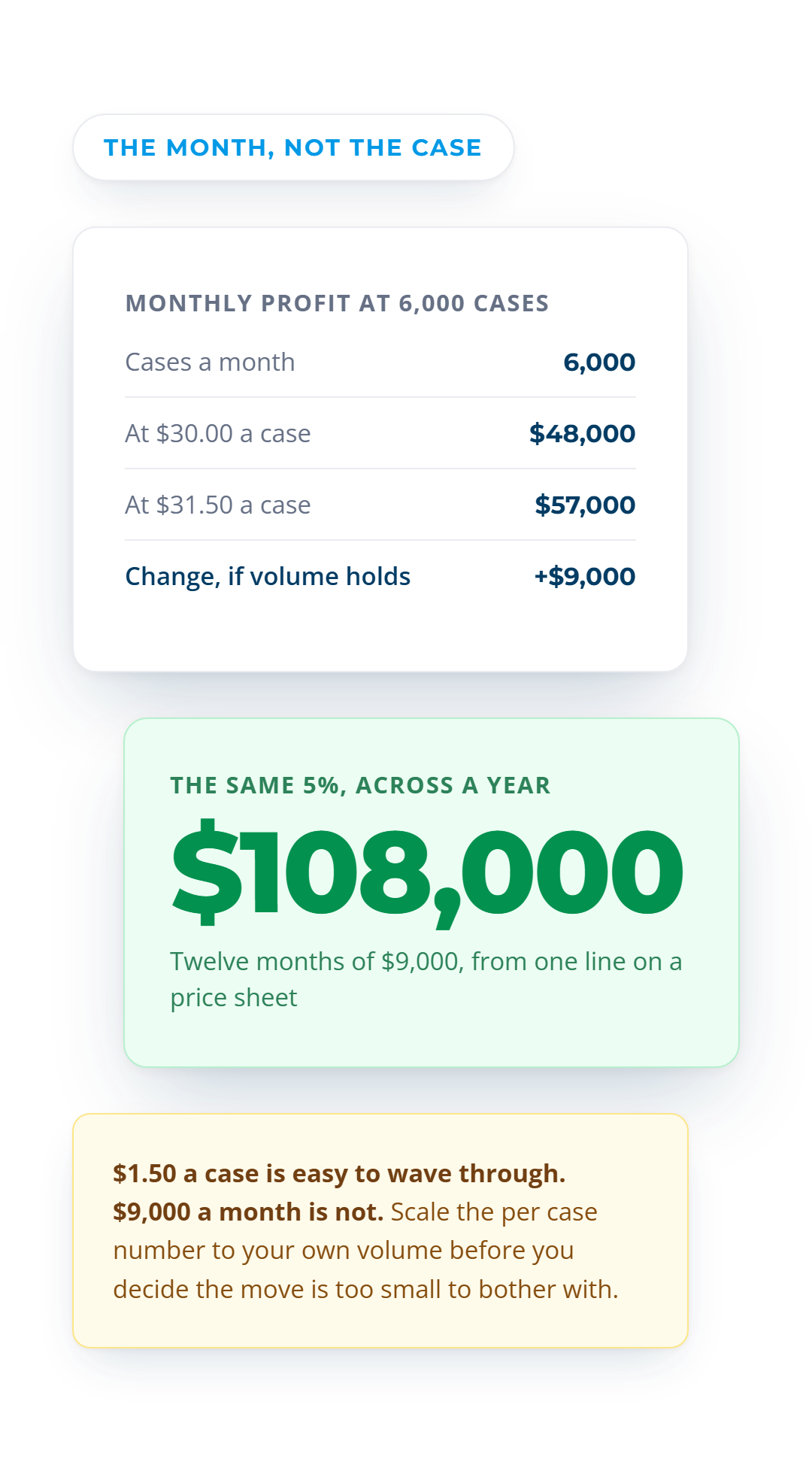
$57,000
Was $48,000
Monthly profit change
+$9,000
If you keep all your volume
A 5.0% increase lifts your margin from 26.7% to 30.2% and adds $1.50 a case. If volume holds you make $9,000 more a month, and you could lose up to 15.8% of your volume before you are worse off. Small price moves have a lot of room.
The riskiest price change is the one you guess at. VoiceOrder Solutions keeps price lists and order guides current, so a change reaches every order the moment you make it.
Book A Demo →
Estimates only. Real volume response depends on your customers and competitors, so treat the breakeven as a guardrail, not a promise.
+$1.50

More gross profit a case from 5% on price

15.8%

Volume you can lose and still match profit

23.1%

Extra volume a 5% cut would need instead

Sound Familiar?

A price move is a volume bet, whether you price it or not

Every pricing conversation is really about how many cases you are willing to lose. Most of them never put a number on it.
Rising trend line for raising the price on an account

We cannot raise prices, we will lose the account.

At 5% you could lose 15.8% of the volume and still match today's profit. That is the number to weigh the risk against, not a feeling.
Percent sign for a five percent price cut

We will drop 5% and make it up on volume.

That needs 23.1% more cases just to stand still. A cut asks far more of volume than a raise gives back.
Level marker showing a small percentage against contribution

It is only five percent.

On price it is 5%. On what you actually keep it is 18.8%, because the whole move lands on the $8.00 of contribution, not the $30.00 of price.
How It Works

How to use the price change calculator

Four numbers, and one of them does not change the answer you came for. That is the useful part.
1

Enter today's price and cost

A $30.00 case costing $22.00 leaves $8.00 of contribution. Everything after this works off that $8.00.
2

Set the move, up or down

5% takes the case to $31.50 and contribution to $9.50. Enter a negative number to model a cut.
3

Read the breakeven, then the month

You can lose 15.8% of volume and break even. Add your case count to see the move in monthly dollars.
What You See

What the calculator shows you

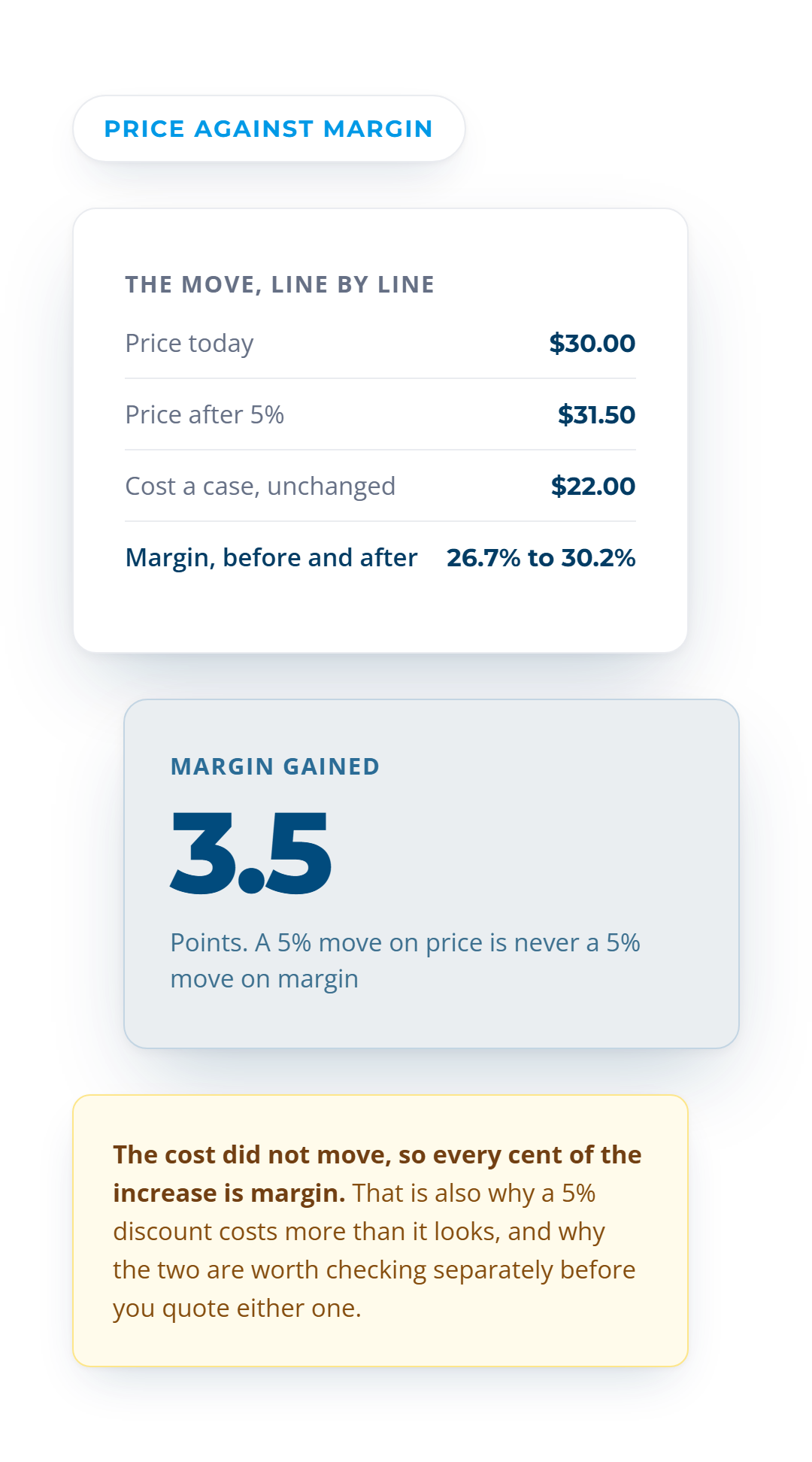
A 5% price increase takes a $30.00 case to $31.50 and lifts the margin from 26.7% to 30.2%
New price and margin

What the move does to your price and your margin

5% on a $30.00 case is $31.50. Margin goes from 26.7% to 30.2%, a gain of 3.5 points, because the whole increase lands on contribution.
Handles a raise or a cut
Shows the old margin beside the new
Settles to whole cents
Slider or typed percentage
Profit per case

The dollars the move adds or takes away

Contribution goes from $8.00 to $9.50, so +$1.50 a case. A 5% move on price is an 18.8% move in what you keep.
Works in dollars, not just percent
Turns red when the move costs you
Reconciles against the price card
Shows how far price moves profit
Contribution per case rising from $8.00 to $9.50 after a 5% price increase, a gain of 18.8%
Breakeven volume tradeoff, a 5% raise can lose 15.8% of cases while a 5% cut needs 23.1% more
Breakeven volume

How much volume you can afford to lose

You can lose 15.8% of cases and still match today's profit. A 5% cut instead needs 23.1% more volume just to stand still.
Flips for a cut automatically
Independent of your current volume
Warns when no volume can pay it back
One number to hand a rep
Monthly impact

The same move in monthly dollars

At 6,000 cases a month, profit goes from $48,000 to $57,000 if volume holds. That is a $9,000 change from 5% on price.
Scales the per case figure to the month
Shows the before and after side by side
Uses your own case count
Totals reconcile to the per case math
Monthly profit at 6,000 cases rising from $48,000 to $57,000 after a 5% price increase
After The Numbers

What to do once you know the breakeven

A breakeven number is only useful if it changes who you move, by how much, and what you tell them.
Target marking the breakeven volume to check before a raise

Check the breakeven before the raise

Dollar sign for pricing off contribution per case

Price off contribution, not margin

Clock for timing a price move with a cost increase

Move with your cost, not after it

Bar comparison for testing a price change on one category

Test one category first

Rising chart of the breakeven volume number to give a rep

Give reps the volume number

Falling line marking the thinnest margin accounts

Watch your thinnest accounts

Invoice document for putting a price change in writing

Put the change in writing

Calendar for rechecking the price move after the first month

Recheck after the first month

Balance scale for holding one pricing rule across reps

Hold one rule across reps

Six Levers

What actually decides whether a price move works

The percentage is the least interesting of these six. The first one decides most of the answer.
Case of product representing contribution per case

Contribution per case

Everything turns on the $8.00 you keep today, not the $30.00 you charge. Thin lines move the most on a small change.
Stacked cases representing volume sensitivity

Volume sensitivity

15.8% is what you can afford to lose. Whether you actually will is an account question, not a math one.
Cash icon representing the timing of a cost increase

Cost timing

A rise that follows a cost increase defends your margin. One that leads it adds to your margin. Say which you are doing.
Order guide list representing account mix by lines bought

Account mix

The same 5% lands differently on an account buying 40 lines and one buying 3. Rank them before you move.
Price tag representing a competitor's quoted price

Competitor position

Worth knowing, never the input. Their cost base is not yours, so their price is not your answer.
Confirmation badge for the price reaching every order

Where the price lives

A change only works if it reaches every order, including the ones placed before anyone is in the office.

See how VOS puts your current pricing on every order

VoiceOrder Solutions builds each customer a personalized order guide from your own SKUs and pricing, so the price you set is the price that comes back.
The Comparison

Three ways to judge a price move, and which one answers the question

Same $30.00 case, same $22.00 cost, same 5% on the table. These are the three things people look at before deciding.

What you need before you move a price

Contribution and breakeven volume

The margin percentage alone

What a competitor charges

Says how much volume you can lose
No, margin says nothing about volume
No
Separates your price from your cost
Yes
No, their cost is not your cost
Works for a cut as well as a raise
Yes
No
Independent of today's volume
Yes
No
Converts to monthly dollars
No, not without a case count
No
Catches a cut that can never pay back
No
No, it hides the payback entirely
Tells a rep what to defend
Only the target, never the tradeoff
Yes, reps quote it already
Means the same across your whole book
Yes
No
Where it falls down
It assumes your cost holds while price moves
26.7% to 30.2% sounds minor, the profit moved 18.8%
It prices your book off someone else's costs
Best used for
Deciding a price move and defending it
Reporting a result, not deciding a move
Knowing where you sit, nothing beyond that
FAQ

Common questions about changing a price

How much volume can you lose after a price increase?
More than most people expect. On a $30.00 case costing $22.00, a 5% increase lets you lose 15.8% of the volume and still match today's profit. That is the number to weigh an account's reaction against, rather than deciding on instinct.
How do you work out the breakeven volume for a price change?
Compare your contribution before and after. $30.00 less $22.00 is $8.00 today, and $31.50 less $22.00 is $9.50 after. Divide the old by the new and you keep 84.2% of the volume to break even, so you can lose 15.8%.
Why does a small price increase move profit so much?
Because the increase lands entirely on what you keep. 5% of a $30.00 price is $1.50, and that $1.50 goes straight onto $8.00 of contribution. The price moved 5% and your profit per case moved 18.8%.
Is a price cut ever worth it?
Sometimes, but it asks much more of volume than a raise gives back. A 5% cut takes contribution to $6.50 and needs 23.1% more cases just to hold profit. If the cut takes the price below your cost, no amount of volume can pay it back.
Does the breakeven depend on how much you sell today?
No, and that is what makes it useful. The breakeven is only the ratio of your old contribution to your new one, so 15.8% is the answer whether you move 600 cases a month or 60,000. Volume only changes the dollars, not the decision.
Should you raise prices across the board or item by item?
Item by item, because the same percentage does very different things to a thin line and a wide one. Run the thin lines first, since those are where a few cents of contribution change the breakeven most.
How do you explain a price increase to an account?
With the reason, the date and the number, in writing, before the invoice shows it. Say whether the move follows a cost increase or not. An account that hears it from a rep first argues less than one that finds it on a statement.

Make a price change stick on every order

VoiceOrder Solutions puts your current pricing in front of every account at order time, so the price you approved is the price that gets ordered.