For Independent Food Distributors

Par Level Calculator

Work out the level you top each line back up to between deliveries, and see what every buffer day of cover ties up in cash.
VoiceOrder app ordering screen

Par Level Calculator

Par is the level you top up to on every order cycle, not the level that tells you to order. The par level formula is average daily usage times the days you have to cover, so put in your usage, your delivery cycle and the buffer you want to carry.

Usage and delivery cycle

cases
Cases a day across a normal week, slow days included.
days
How long this par has to last. A weekly drop is 7, a twice weekly DSD route is 3 or 4.

The buffer you carry

days
The only judgement call in a par level calculation. Two days is normal on a supplier who misses dates.
$
What a case costs you landed, so par can be priced in cash and not just cases.

Where you are right now

cases
What is on the floor today, counted rather than remembered.
Par level
1,080 cases
120 cases a day across the 7 days between deliveries, plus a 2 day buffer
Top up to par today
740 cases
1,080 par less the 340 cases on hand
Days of cover at par
9.0 days
1,080 cases at 120 a day
Cash tied up at par
$23,760
1,080 cases at $22.00
This top up costs
$16,280
740 cases at $22.00
Dropping to a 1 day buffer
$2,640 freed
Par falls to 960 cases, $21,120 of stock
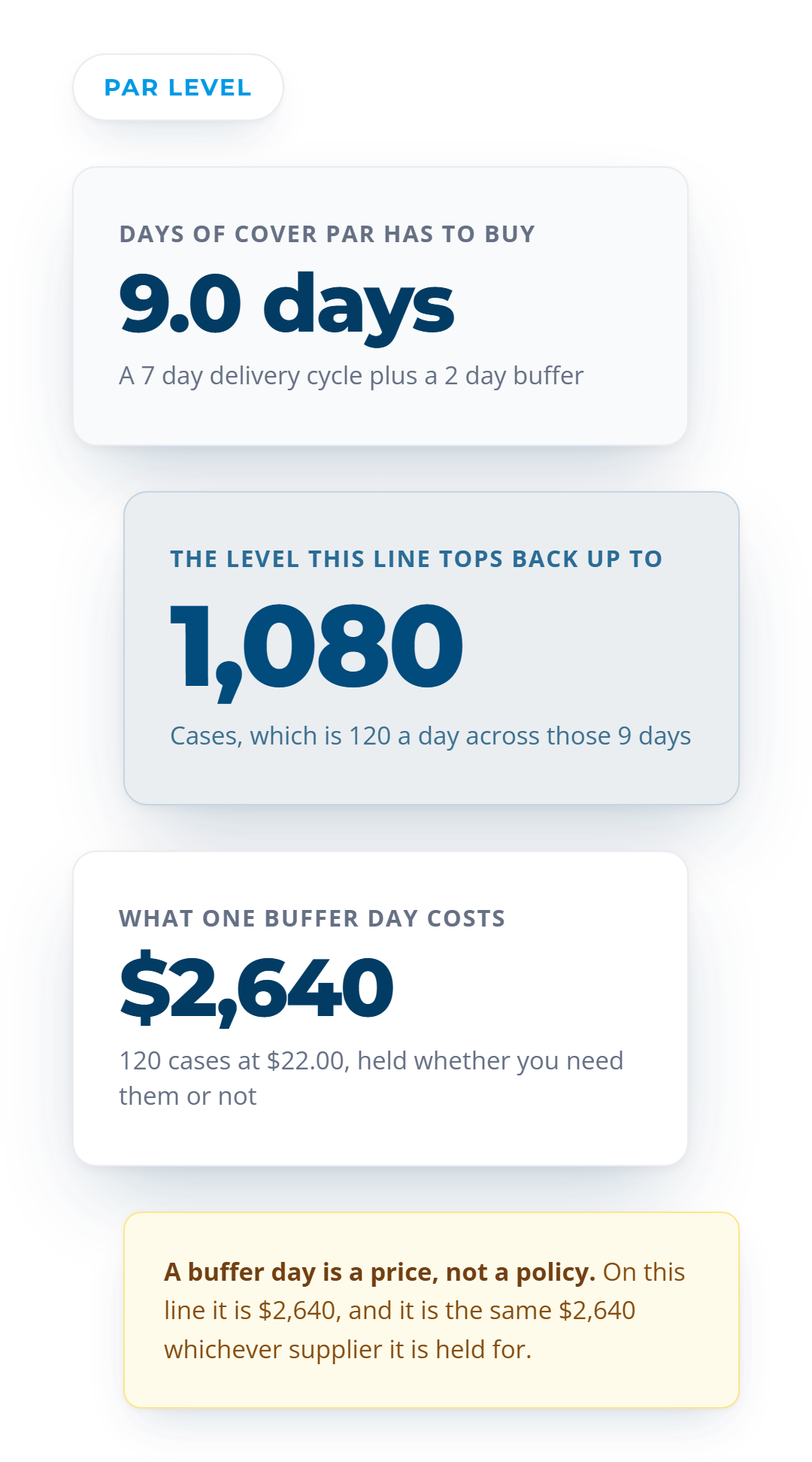
Each buffer day on this item is $2,640 of stock, because 120 cases a day at $22.00 is what a day of cover costs. 2 days of buffer is the right call on a supplier who misses dates and an expensive habit on one who never does, so set the buffer per supplier rather than across the whole order guide.
Par only works if the on hand number is real. VoiceOrder Solutions keeps inventory visibility current as orders are processed, so the stock figure you set par against is a current one and not a count from last week.
Book A Demo →
Estimates only. The par level definition used here is the standard one, average usage across the days you must cover plus a buffer, with no forecast in it. Par answers what level you top up to; the level that tells you when to order is a reorder point, which is a separate calculation. Recheck par whenever usage or the delivery cycle moves.
1,080 cases

The level this line tops back up to every cycle

9.0 days

Cover a 7 day cycle plus a 2 day buffer buys

$2,640

What one buffer day of that cover costs

Sound Familiar?

A par level is a number, not a feeling about the shelf

Topping up to whatever looks right is how one line sits 120 cases over par while the next one runs dry mid cycle.
A week of cover with no buffer

We order enough to get through the week.

A week is 7 days of cover, so 120 cases a day puts par at 840 cases and nothing more. One late truck and the week runs out on day seven.
Dollars tied up in spare days

We always keep a couple of days spare.

2 buffer days on this line is $5,280 of stock, because 120 cases a day at $22.00 is $2,640 a day. Price the day before you commit to it.
Cases counted on the rack

The count said 340 cases.

Then this cycle is a 740 case top up, $16,280 at $22.00 a case. A count that is a week old makes the order wrong by exactly as much as the count is.
How It Works

How to use the par level calculator

Three numbers set the level. A fourth prices it in cash, and the last one turns it into the order you place today.
1

Enter your usage and your delivery cycle

120 cases a day across 7 days between deliveries is 840 cases of bare cover. A twice weekly DSD route is 3 days, not 7.
2

Add the buffer days you want to carry

A 2 day buffer takes par to 1,080 cases, which is 9.0 days of cover. The buffer is the only judgment call in the whole calculation.
3

Put in a case cost and today's count

Par is $23,760 of stock at $22.00 a case, and 340 cases on hand makes this cycle a 740 case order worth $16,280.
What You See

What the calculator shows you

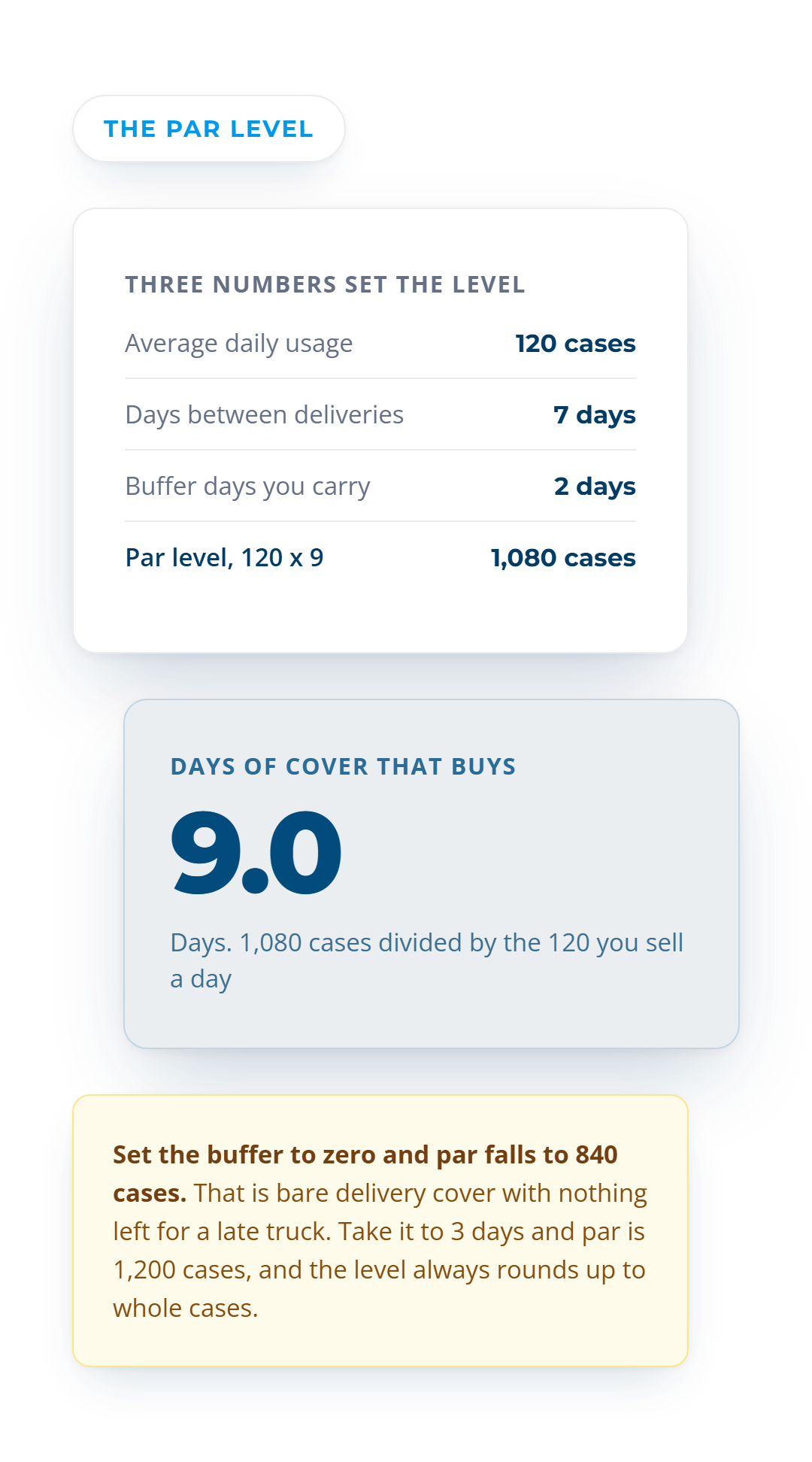
Three inputs setting a par level: 120 cases a day, 7 days between deliveries and a 2 day buffer put par at 1,080 cases, which is 9.0 days of cover.
The par level

The level every cycle tops this line back up to

120 cases a day across 7 days between deliveries plus a 2 day buffer puts par at 1,080 cases, which is 9.0 days of cover.
Splits cover into cycle and buffer
Rounds up to whole cases
Works with no buffer at all
Recalculates as you type
Today's top up

How many cases this cycle's order has to bring in

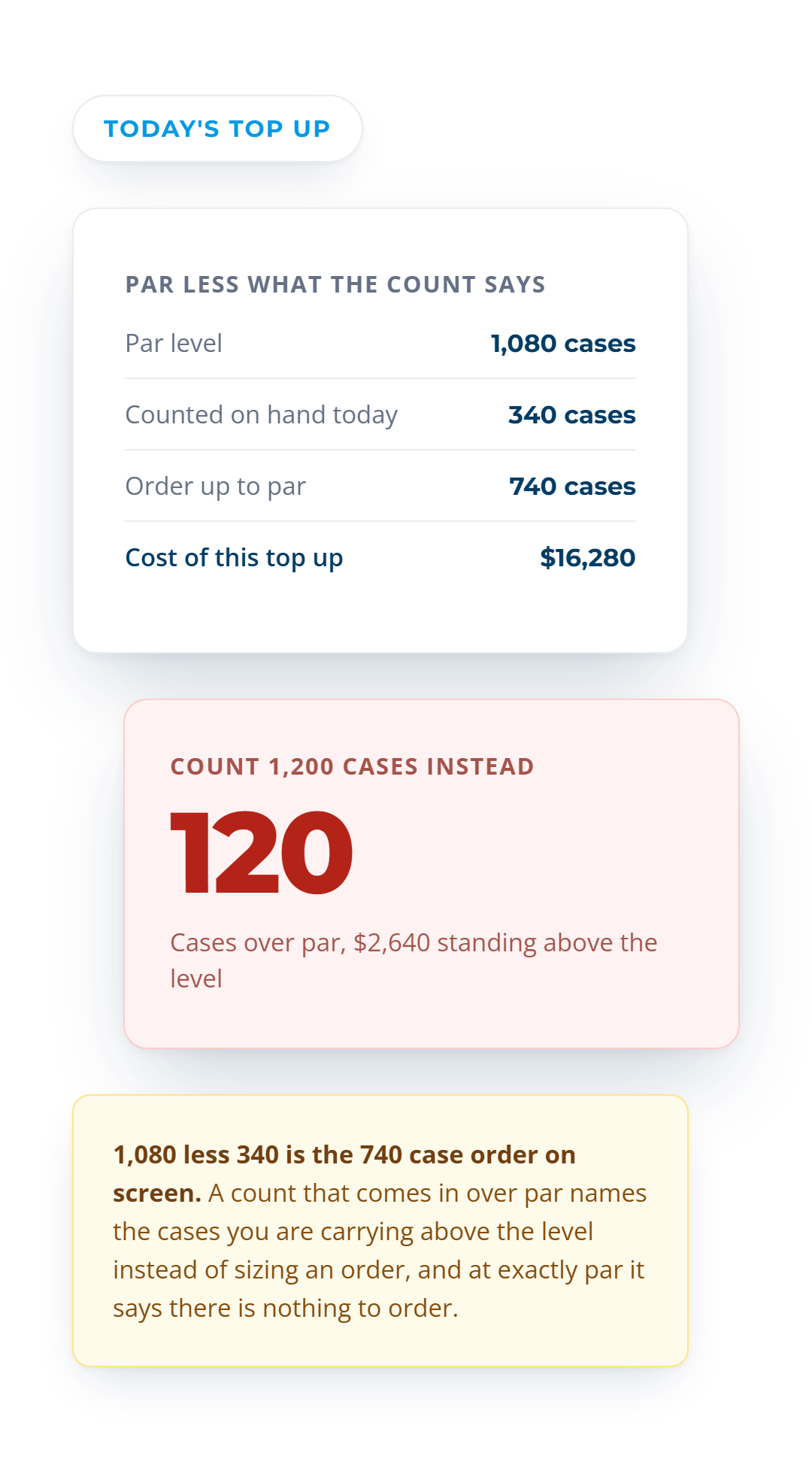
1,080 par less the 340 cases on hand is a 740 case order, $16,280 at $22.00. Count 1,200 instead and the card turns red at 120 cases over par.
Sizes the order off today's count
Names it in cases and in dollars
Flags stock sitting over par
Says nothing to order when you are at par
Par of 1,080 cases less the 340 counted on hand sizes a 740 case order worth $16,280, with a red card showing 120 cases over par at a count of 1,200.
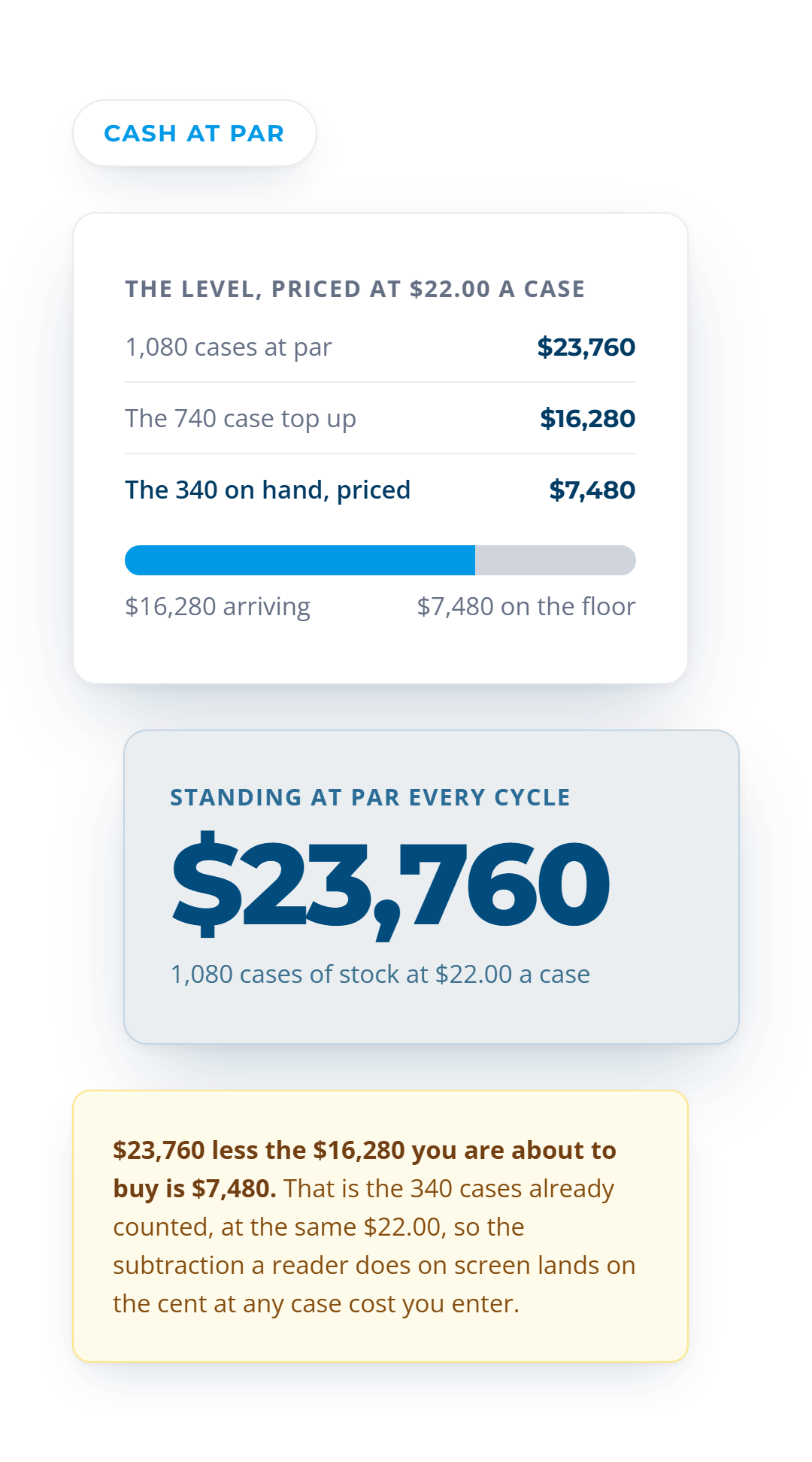
Par priced at $22.00 a case: $23,760 standing at par, split into the $16,280 this cycle has to buy and the $7,480 of stock already on the warehouse floor.
Cash at par

What the level you chose is holding in stock

1,080 cases at $22.00 is $23,760 standing on the floor. Take off the $16,280 you are about to buy and the 340 on hand are the $7,480 left.
Prices par in cash, not just cases
Prices this cycle's order separately
Settles the case cost to whole cents
Holds at any case cost you enter
A buffer day

What one day of buffer actually costs

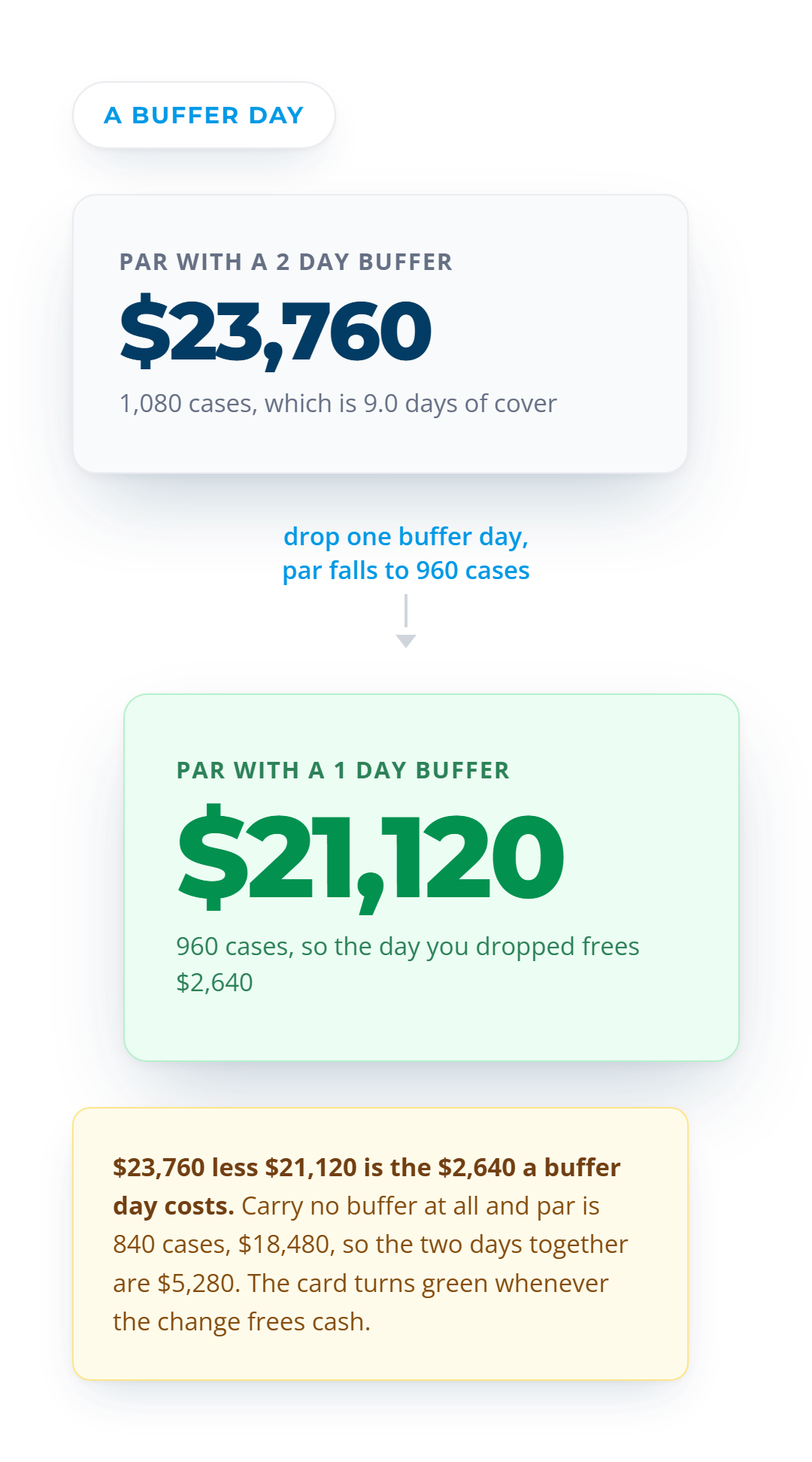
Drop from 2 days of buffer to 1 and par falls to 960 cases, $21,120 of stock, freeing $2,640. That is the price of a day of cover on this line.
Prices one buffer day at a time
Slider from no buffer to a week
Clamps a fat finger at 30 days
Turns green when the change frees cash
Dropping from a 2 day buffer to 1 day takes par from 1,080 cases at $23,760 down to 960 cases at $21,120, freeing the $2,640 one buffer day costs.
After The Numbers

What to do once you have a par level

A par level is only worth what the habits behind it are worth. These nine keep the number honest.
Order guide lines

Set par per line, not per shelf

Delivery cycle in days

Use the delivery cycle you really get

Cases used per day

Count usage on slow days too

Buffer compared supplier by supplier

Set the buffer per supplier

Par level priced in cash

Price par in cash, not cases

Stock count confirmed before ordering

Count before you order to par

Par held down on short shelf life

Hold par down on short shelf life

Usage moving up

Reset par when usage moves

Quarterly par review cycle

Review every par level quarterly

Six Levers

What moves a par level, and what only looks like it does

Three of these six sit inside the par level formula. The other three decide whether the level survives contact with the warehouse.
Days between deliveries on your route

The days between deliveries

7 days here. A twice weekly route at 3 days takes par from 1,080 cases to 600, and the cash at par from $23,760 to $13,200.
Average daily case volume

Average daily usage

120 cases a day has to be the average across a normal week. Take it off a busy week and every buffer day costs more than $2,640.
Buffer days above the par line

The buffer days you pick

The only judgment call in the calculation. Going from 2 days to 3 takes par to 1,200 cases and the cash at par to $26,400.
Supplier hitting the promised day

Supplier reliability

A supplier who unloads on the promised day needs no buffer day at all. One who misses dates costs you $2,640 for every day you cover.
How long since the last count

How current your count is

Par becomes an order by subtracting what is on the floor. A count from last Thursday turns a 740 case order into a guess.
Shelf life and spoilage

Shelf life

9.0 days of cover is nothing on a dry good and too much on a fresh line. Par has to clear the shelf before the product does.

See how VOS timestamps every order it takes

VoiceOrder Solutions numbers and dates every order placed in it, and keeps them in one order history. The 120 cases a day you feed par then come off a record, not a memory.
The Comparison

Three ways to size a top up order, and which one holds

Same 120 cases a day, same 7 days between deliveries, same $22.00 case. These are the three ways the order actually gets sized.

What you need before you size the next order

Usage across the cycle plus a buffer, priced in cash

A number written on the shelf tag

Ordering what you ordered last time

Names the level to top back up to
Yes, but nobody recalls what it assumed
No, the last order is not a level
Moves with your delivery cycle
No, a tag does not know the cycle
No, last month set the quantity
Keeps the buffer as its own number
No, the buffer is buried in one number
No
Prices the level in cash
No, not without a case cost
Only by accident
Sizes today's order off the count
Only if somebody counts first
No, it starts from the invoice, not the floor
Flags stock sitting over par
No, over par and at par look the same
No, over par just compounds
Tells a buyer how much, not when
Yes
Yes, it gives you a quantity
Works on a fast and a slow mover
No, the same tag goes on both
No, a fast mover runs dry mid cycle
Where it falls down
It trusts the usage and the cycle you type, so a holiday week sets par high
It was written once and the cycle changed
Last month's usage sizes this month's order
Best used for
Sizing the top up on any line you reorder on a cycle
Cheap lines where being wrong costs little
Dead steady lines on a fixed route
FAQ

Common questions about par levels

What is a par level?
The stock level you top a line back up to on every order cycle. It is the usage you will sell across the days you have to cover plus the buffer you carry, so 120 cases a day across 7 days between deliveries plus a 2 day buffer is a par level of 1,080 cases. It tells you what level to reach, not when to order.
What is the par level formula?
Average daily usage times the days you have to cover, where those days are your delivery cycle plus your buffer. Here that is 120 x 9, so 1,080 cases. The par level calculation rounds up to whole cases, and today's order is par less whatever the count says is on the floor.
How is a par level different from a reorder point?
A par level answers how much, and a reorder point answers when. Par here is 1,080 cases, the level the next delivery brings this line back to. A reorder point is a level on the way down that says place the order now. On a line that matters you want both numbers, and they are two separate calculations.
How many buffer days should a par level carry?
Price the day before you pick it. One buffer day on this line is $2,640 of stock, so 2 days is $5,280 sitting there for a supplier who misses dates. On a supplier who unloads on the promised day, carry one day or none and put the $2,640 somewhere it earns.
How much cash does a par level tie up?
Multiply par by your landed case cost. 1,080 cases at $22.00 is $23,760 on the floor at the top of every cycle. Take out one buffer day and par falls to 960 cases, which is $21,120, so the day you were carrying was worth $2,640 of working capital.
How do you work out how much to order up to par?
Subtract today's count from par. 1,080 par less 340 cases on hand is a 740 case order, $16,280 at $22.00 a case. If the count comes in over par, the calculator names how many cases you are carrying above the level instead of sizing an order.
How often should you reset your par levels?
Whenever usage or the delivery cycle moves, and on a quarterly sweep otherwise. Going from a weekly drop to a 3 day route takes this par level from 1,080 cases to 600 and the cash at par from $23,760 to $13,200. A par level definition set last spring is still priced at last spring's case cost.

Set par against numbers you can trust

VoiceOrder Solutions keeps inventory visibility updating as orders are processed. The on hand number you subtract from a 1,080 case par is then current, not last Thursday's.