For Independent Food Distributors

Inventory Carrying Cost Calculator

Build your carrying rate from the five costs you already pay, then read what holding stock costs you a year, a month and a case.
VoiceOrder app ordering screen

Inventory Carrying Cost Calculator

The inventory carrying cost formula is one rate times your average stock. The rate is the part people guess at, so this builds it from the five lines you already pay and shows which one dominates.

The stock you hold

$
Average, not peak: twelve month end balances at cost, averaged. Calculate inventory carrying costs off a peak month and every figure below reads high.
cases
Cases you ship in a year. Used to put the rate on a single case.

The five parts of the rate

%
What the money sitting in that stock would earn elsewhere, or what your line of credit costs, whichever is higher.
%
Rent or depreciation on the space, racking, cooler and freezer load, and the labor to move a case twice.
%
Dated product, damage, short codes and the cases you dump. This is the line a dry goods benchmark leaves out.
%
Inventory insurance and any personal property tax on stock on hand.
%
Discontinued SKUs, a promotion that did not move, and seasonal product you end up marking down.
Total carrying cost rate
27%
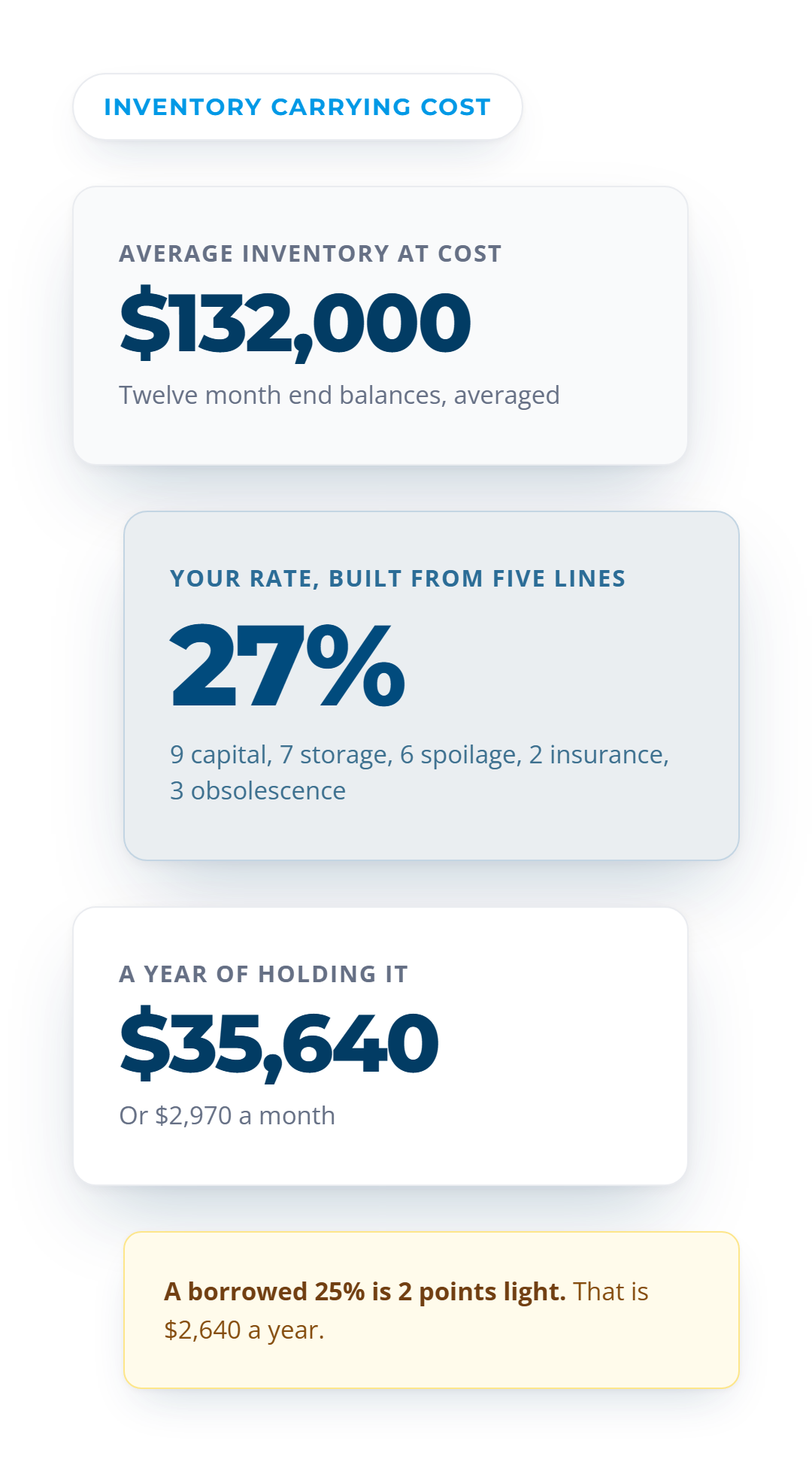
9 capital, 7 storage, 6 spoilage, 2 insurance, 3 obsolescence
Annual carrying cost
$35,640
27% of $132,000 of average inventory
Biggest component
Cost of capital
9 of the 27 points, $11,880 a year
Carrying cost a month
$2,970
$35,640 a year across 12 months
Carrying cost per case
$0.50
$35,640 across 72,000 cases a year
Hold 10% less stock
$3,564
Saved a year, with average inventory at $118,800

Where the rate comes from

Cost of capital
$11,880
9 points, 33.3% of the rate
Storage and handling
$9,240
7 points, 25.9% of the rate
Shrink and spoilage
$7,920
6 points, 22.2% of the rate
Insurance and taxes
$2,640
2 points, 7.4% of the rate
Obsolescence
$3,960
3 points, 11.1% of the rate
At 27% the textbook 25% rule of thumb understates what your stock costs you, and the reason is shrink and spoilage at 6 points, worth $7,920 a year on its own. A dry goods distributor can use the textbook number. You carry product with a date on it, so you cannot.
Spoilage is the component you can actually move. VoiceOrder Solutions keeps inventory updating in real time as orders are processed and flags low stock early, so you buy against a live count instead of a stale one.
Book A Demo →
Estimates only. What is inventory carrying cost in practice: five costs you already pay, expressed as a rate on the stock they sit against. It does not include the purchase cost of the goods.
27%

A carrying rate built from five costs you already pay

$35,640

A year of holding $132,000 of average inventory

6 of 27 points

Shrink and spoilage, the line a dry goods benchmark drops

Sound Familiar?

The stock is already paid for, so nobody prices the holding

What is inventory carrying cost? The rate you pay every year just to keep stock on the floor. Borrow the rate and you get it wrong in one direction.
Percent sign for a borrowed 25% carrying rate

We use 25%, everybody does.

Built from your own lines it is 27%, and those 2 points are $2,640 a year. That is the same as your entire insurance and taxes line.
Price tag putting a cost on spoiled product

Spoilage is a dump log, not a cost.

It is 6 of the 27 points, worth $7,920 a year on $132,000 of average stock. That makes it the third biggest line in the rate.
Five stacked components behind one carrying rate

Carrying cost is just the interest.

Cost of capital is 9 points of the 27, so it is a third of it. Storage, spoilage, insurance and obsolescence are the other $23,760.
How It Works

How to calculate inventory carrying costs

Two numbers about your stock, then five rates. The five rates are the work, and they are what makes the answer yours.
1

Enter average inventory and cases a year

$132,000 averaged across twelve month end balances, and 72,000 cases shipped. The case count is what puts the rate on one case.
2

Set the five components in points

9 capital, 7 storage, 6 spoilage, 2 insurance, 3 obsolescence adds up to a 27% rate. Every one of them is a cost you can already name.
3

Read which line dominates

Capital is $11,880 of the $35,640 and takes the highlight. Push spoilage to 15 points and the highlight moves to it at $19,800.
What You See

What the calculator shows you

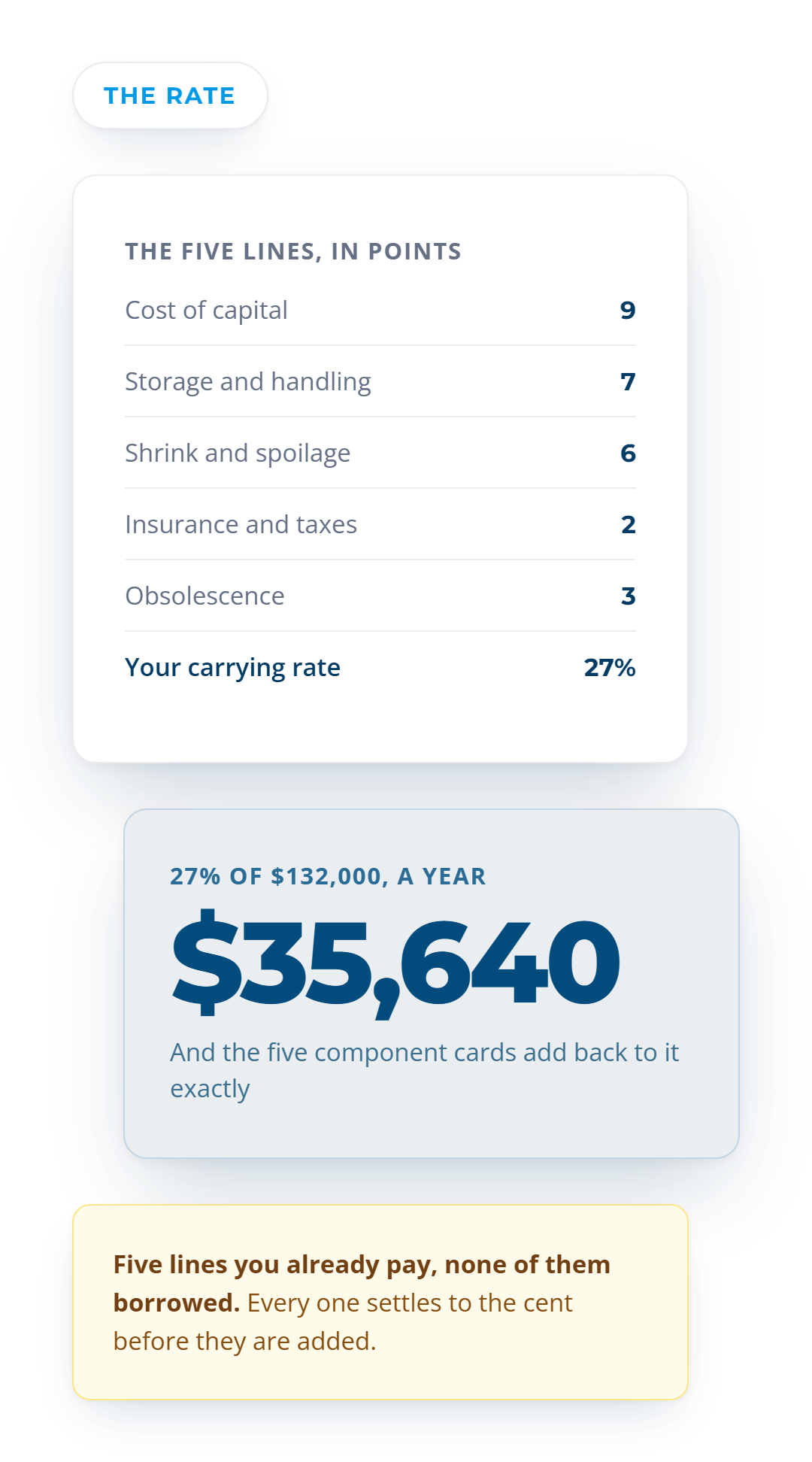
Five carrying cost lines in points, 9 capital, 7 storage, 6 spoilage, 2 insurance and 3 obsolescence, adding to a 27% rate and $35,640 a year.
The rate

A carrying rate built, not borrowed

9 plus 7 plus 6 plus 2 plus 3 is 27%, and 27% of $132,000 is $35,640 a year. Each component settles to the cent first, so the five cards add up to the annual card exactly.
Five components, each one in points
Components add to the annual cost exactly
Slider on the cost of capital
Clamps one component at 100 points
The dominant line

Which component is actually costing you

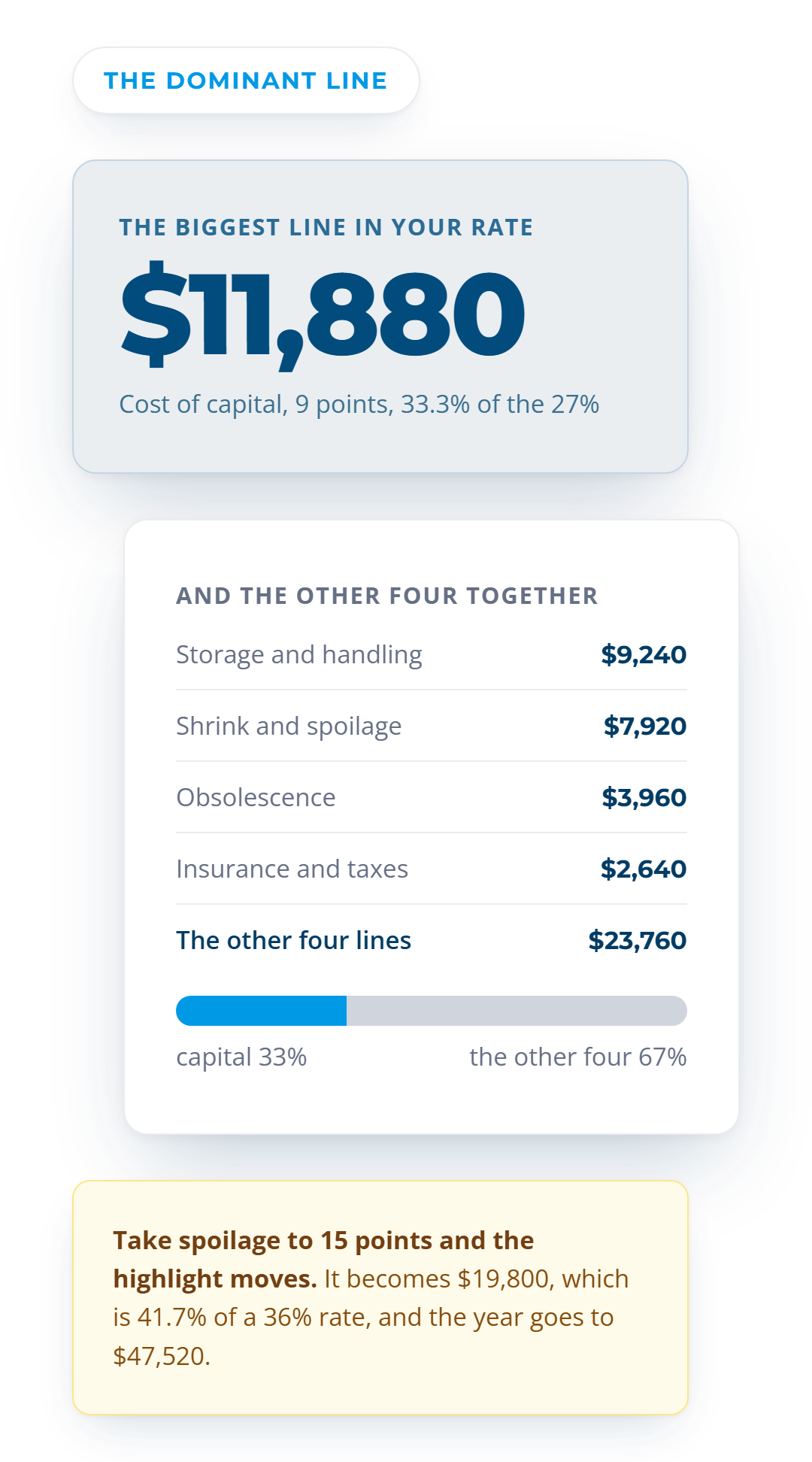
Capital is $11,880, which is 33.3% of the rate. Take spoilage to 15 points and the highlight moves to shrink and spoilage at $19,800, 41.7% of a 36% rate.
Highlights the biggest line for you
Moves the highlight as you type
Names each line in points and dollars
A tie goes to the cost of capital
Cost of capital highlighted at $11,880, a third of the 27% rate, with the other four lines at $23,760 between them.
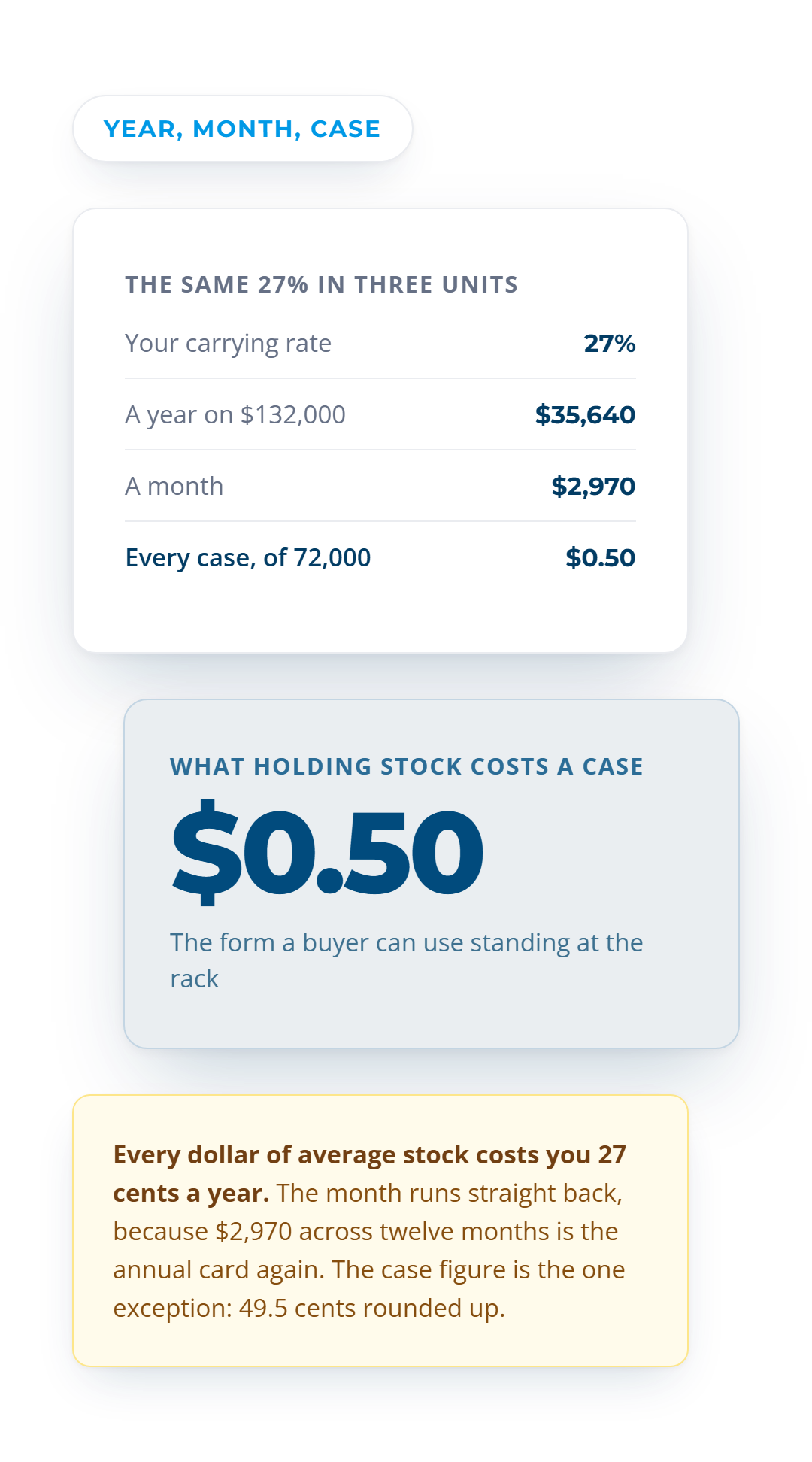
The same 27% carrying rate read three ways, $35,640 a year, $2,970 a month and $0.50 on each of 72,000 cases.
Year, month, case

The same rate in three units

$35,640 a year is $2,970 a month and $0.50 on every case out of 72,000. The per case figure is the one a buyer can use on the spot.
Monthly is the annual across twelve months
Per case uses your real case count
Asks for cases rather than dividing by zero
Rounds the case figure up from 49.5 cents
Holding less

What 10% less stock is worth

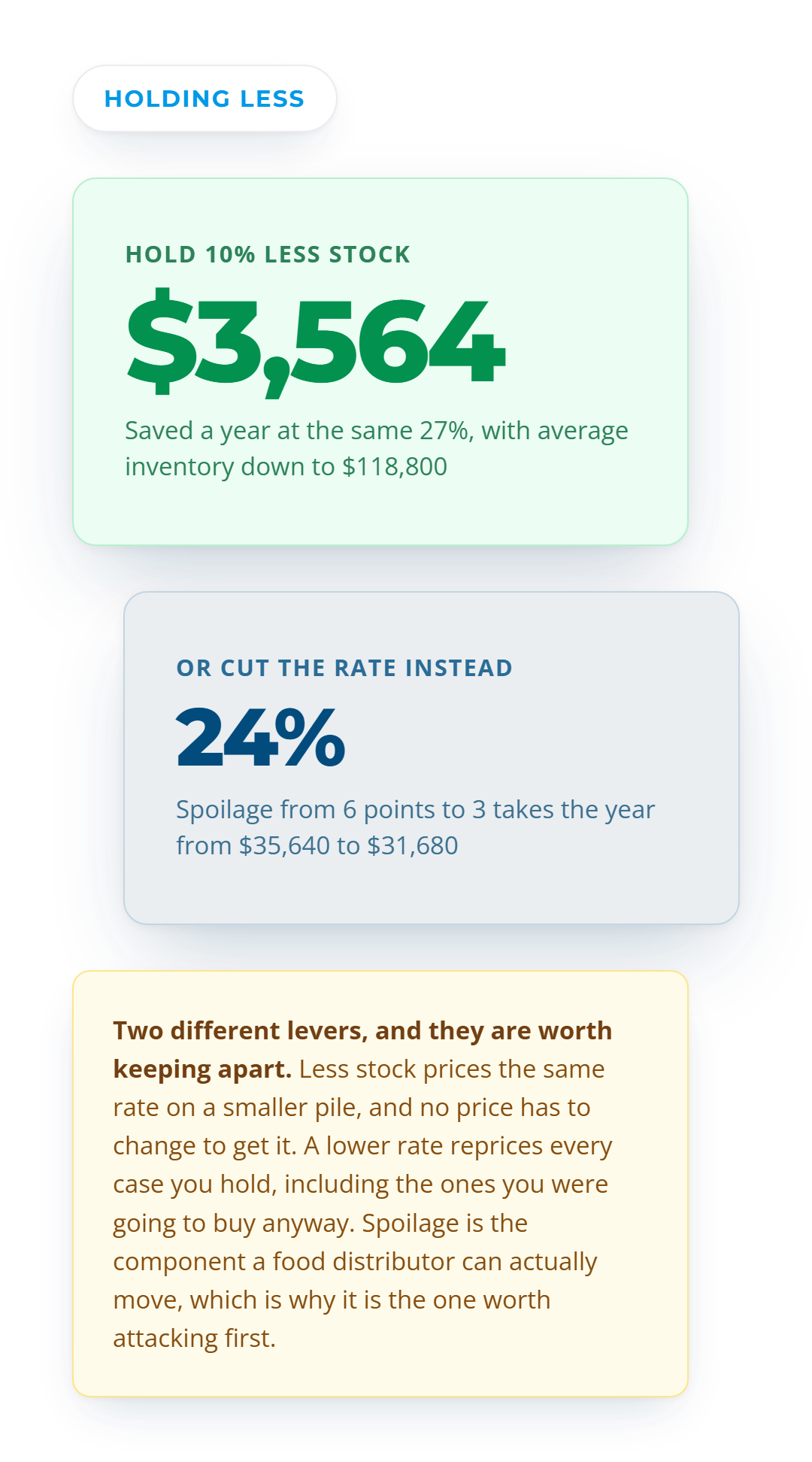
Average inventory at $118,800 instead of $132,000 saves $3,564 a year at the same rate. Cut spoilage from 6 points to 3 and the rate drops to 24% and $31,680.
Prices a 10% cut in average stock
Reprices every card as the rate moves
Separates a stock cut from a rate cut
Survives a zero rate without breaking
Holding 10% less stock saves $3,564 a year, and cutting spoilage from 6 points to 3 drops the rate to 24% and $31,680.
After The Numbers

What to do once you know the rate

A rate is only worth having where a buying decision gets made. These nine habits put the 27% to work.
Calendar for averaging twelve month end inventory balances

Average twelve month end balances

Cash priced at the rate your line of credit costs

Price capital at your credit rate

Warehouse including the cooler and freezer load

Count the cooler and freezer load

A log listing every dumped case as a cost

Log every dumped case as a cost

Balance scale keeping shrink apart from obsolescence

Keep shrink apart from obsolescence

A single case carrying the per case cost figure

Put the per case figure in front of buying

Clock for short shelf life lines

Check it against your short shelf life lines

Bar comparison of two buys at the same carrying rate

Hold the rate still when you compare buys

Cycle arrows for rebuilding the rate once a year

Rebuild the rate once a year

Six Levers

What actually moves your carrying cost

Five of these six set the rate. The sixth is how much stock the rate sits on, and both ends land in the same $35,640.
Dollar sign for the cost of capital tied up in stock

The cost of your money

9 points here, the biggest single line at $11,880 a year. Use what your line of credit costs, not what a savings account pays.
Racking for the space and handling component

Space and the labor to move a case

7 points, $9,240 a year. Rent or depreciation, racking, the cooler and freezer load, and the labor to touch a case twice.
Product lost to shrink and spoilage

Shrink and spoilage

6 points, $7,920, and the line a dry goods benchmark drops. Dated product and short codes are a carrying cost, not an accident.
A bill for insurance and property tax on held stock

Insurance and property tax

2 points, $2,640 a year. Small on its own, and exactly the gap between a borrowed 25% and your real 27%.
Falling line for product marked down as obsolete

Obsolescence

3 points, $3,960 a year. Discontinued items, a promotion that did not move, and seasonal product you end up marking down.
Stock level showing how much inventory you average

How much you average

The rate is only half of it. The same 27% on $118,800 of average stock is $3,564 a year cheaper than on $132,000.

See how VOS keeps the stock picture current as orders are processed

VoiceOrder Solutions gives you visibility across the full catalog, so you get fewer stockout surprises. Most distributors are live in 24 to 48 hours.
The Comparison

Three ways to price the stock you hold, and which one holds up

Same $132,000 of average inventory, same 72,000 cases a year. These are the three ways the cost of holding it gets set.

What you need before you size the next buy

A rate built from your own five components

A borrowed 25% rule of thumb

Counting the interest and nothing else

Gives you a rate you can defend
Only if your costs match the textbook
No, it stops at the cost of money
Names which line dominates
No, it arrives as one number
No, there is only one line in it
Prices spoilage as a cost
No, it is averaged in and invisible
No
Puts the cost on a single case
Yes, but off a rate that is not yours
Yes, at 9 points instead of 27
Reprices when a component moves
No, it never moves
Yes, it tracks your credit rate
Keeps the rate apart from the stock level
Yes
Yes
Fits a cooler line and a dry line
No, the same 25% on both
No, a dated line and a dry line read the same
Needs nothing you do not already have
Yes
Yes
Where it falls down
It is only as honest as the five rates you type, and spoilage is the one people guess at
It is 2 points light here, which is $2,640 a year
It prices $11,880 of a $35,640 cost
Best used for
Sizing a buy, a promotion or a slow line against what holding it costs
A placeholder until you build your own
A borrowing decision, not a buying decision
FAQ

Common questions about inventory carrying cost

What are examples of carrying costs?
Five lines you already pay: the cost of capital tied up in the stock, storage and handling, shrink and spoilage, insurance and taxes, and obsolescence. On $132,000 of average inventory they run $11,880, $9,240, $7,920, $2,640 and $3,960, which is $35,640 a year. The purchase cost of the goods is not one of them.
What are the four types of inventory costs?
Purchase cost, ordering cost, carrying cost and shortage cost. This tool does the third one only, so the $35,640 is what holding the stock costs you and not what buying it cost. Carrying cost is the one that never arrives as an invoice, which is why it gets left at a guess.
What is the formula for calculating annual inventory carrying cost?
Add the five component rates to get your carrying rate, then multiply it by average inventory at cost. 9 plus 7 plus 6 plus 2 plus 3 is 27%, and 27% of $132,000 is $35,640 a year. Use an average of twelve month end balances, because a peak month reads high.
How to determine inventory carrying cost?
Build it from the lines you already pay. Capital is what your credit line costs. Storage is rent plus racking plus the labor to touch a case twice, spoilage is last year's dump log over average inventory, insurance comes off the policy, and obsolescence is what you marked down to clear. Added up they are 9, 7, 6, 2 and 3 points, a 27% rate, which is $35,640 on $132,000 of average stock.
What is the formula for calculating inventory cost?
The inventory carrying cost formula is your carrying rate times average inventory value. Divide the answer by twelve for a month, $2,970 here, or by cases a year to cost one case. Inventory cost in the wider sense also carries the purchase price of the goods, which this leaves out on purpose.
How much inventory should you carry?
Less than feels comfortable, because every dollar of average stock costs you 27 cents a year. Taking average inventory down 10% to $118,800 saves $3,564 a year and no price has to change. Set the floor on the service you owe your accounts, then stop.
What is the 80/20 rule in inventory?
Roughly a fifth of your items carry most of the inventory value, so price those first. The rate is the same across the warehouse, but it lands unevenly: the lines that sit longest pay the spoilage and obsolescence points hardest, 6 points and 3 points of the 27. Work the top of that list and the $35,640 moves.

Spoilage is the component you can actually move

VoiceOrder Solutions runs alongside the inventory system you already have, which stays your system of record. The catalog updates as stock levels change, so the $132,000 average behind your 27% stays current.