For Independent Food Distributors

Early Payment Discount Calculator

See what paying your supplier early is really worth as a yearly rate, and what the case costs after both discounts and freight.
VoiceOrder app ordering screen

Purchase Price Calculator

The number on the price list is not what the case costs you. Put in the list price, the discounts you have earned and the freight to calculate the purchase price you are really paying per case.

What the supplier quotes

$
The quoted price before anything comes off. If you bought this item at more than one price, use the average purchase price for the period.
$
Inbound freight split across the cases on the truck. It goes on after the discounts, so it never gets discounted.

Discounts you have earned

%
Off invoice for the tier you buy at. Rebates paid later belong in a separate line, not in here.
%
The points you keep for paying inside the window. It comes off the price after the volume discount.

Payment terms

days
The discount window. On 2/10 net 30 this is the 10.
days
When the invoice is due anyway. The gap between the two is what the discount is really buying.

Monthly volume

cases
How many cases of this item you buy in a month.
Net purchase price per case
$23.51
$22.11 after both discounts, plus $1.40 of freight
Price after both discounts
$22.11
$24.00 list, less 6% volume, then 2% early pay
Total off the list price
7.9%
$1.89 a case off list, against $1.40 of freight
Monthly purchase spend
$141,060
6,000 cases at $23.51, freight in
Early pay discount is worth
$2,700
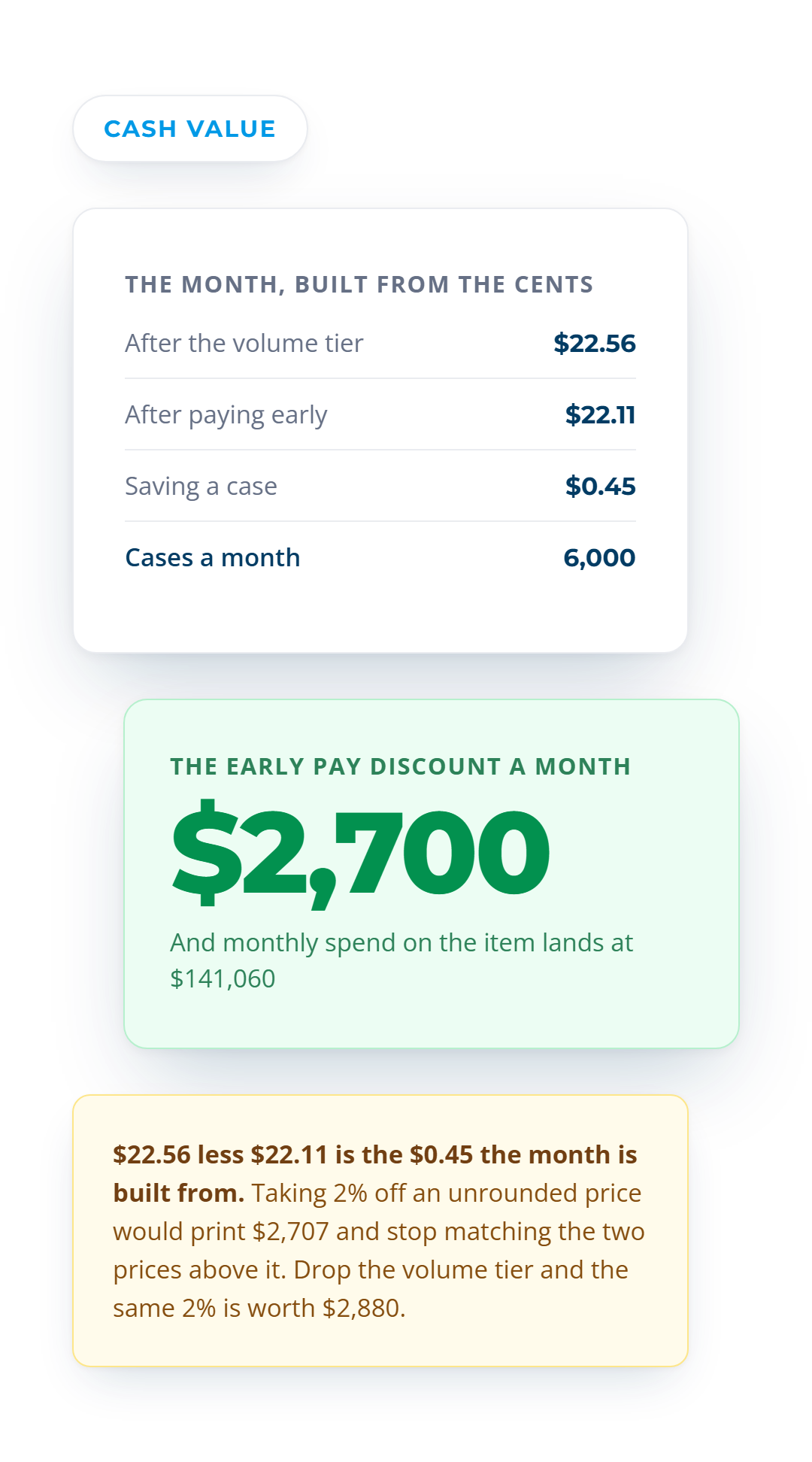
$0.45 a case, the $22.56 volume price less $22.11, across 6,000 cases
Annualized value of 2/10 net 30
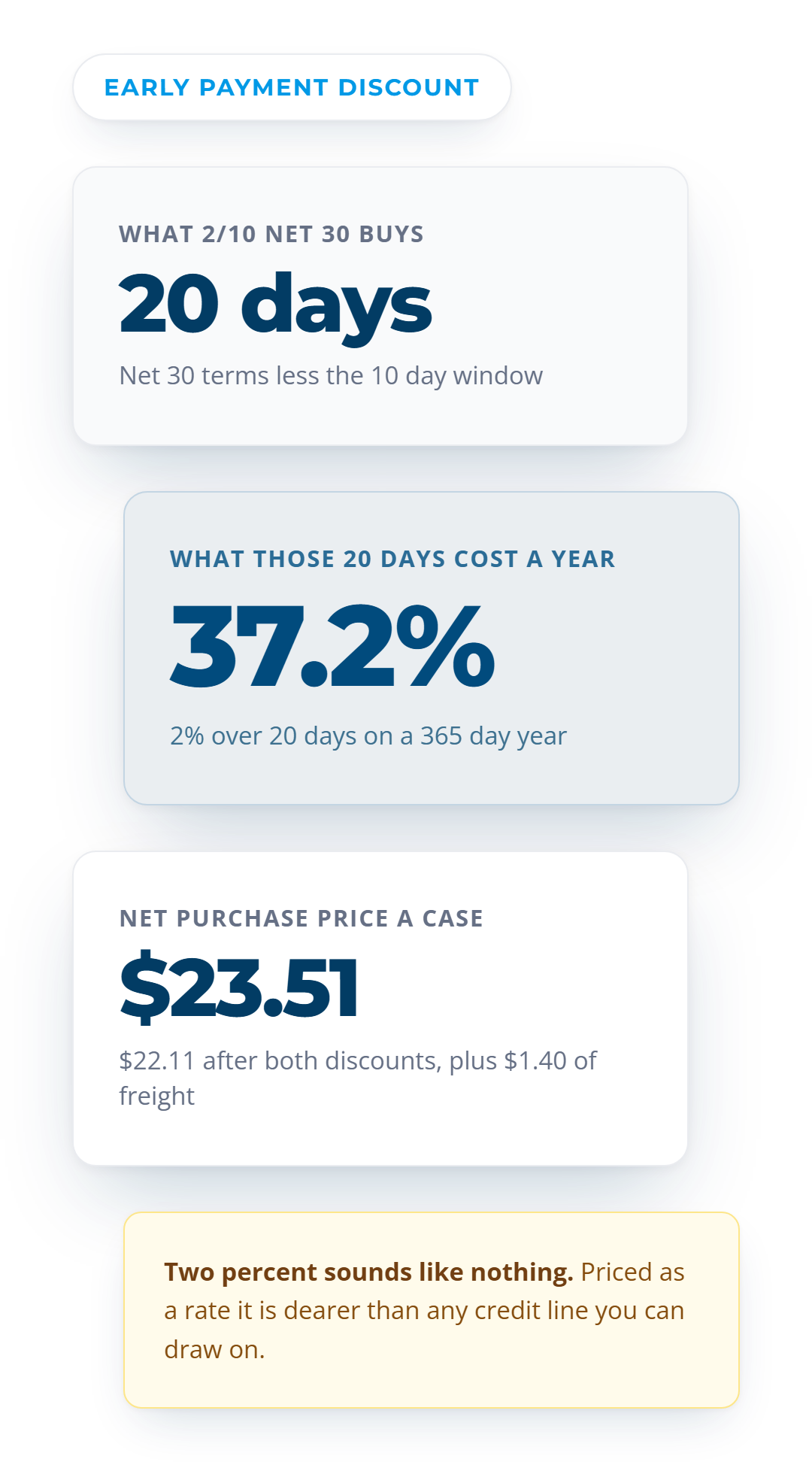
37.2%
Keeping 2% to pay 20 days early
Taking 2/10 net 30 is worth 37.2% a year on the money, which is $2,700 a month at this volume. There is no cheaper money than that, so clear the early pay invoices before you borrow for anything else.
You buy against what your accounts actually order. VoiceOrder Solutions captures those orders as they come in and keeps inventory visibility current, so the volume you negotiate a discount tier on is the volume you really move.
Book A Demo →
Estimates only. Buy side only, so there is no selling price or margin in here. Freight sits as a flat cost per case, a cost of goods purchased calculation at the account level would also carry the cost of raising each purchase order, and a purchase price variance calculation against your standard cost is a separate job.
37.2%

What 2/10 net 30 is worth a year on your cash

$2,700

A month of early pay discount across 6,000 cases

$23.51

Net purchase price a case, freight added back

Sound Familiar?

The discount you skipped was the cheapest money on the table

Paying 20 days early feels like handing cash away. Priced as a rate, the number says the opposite.
Cash held back until the net terms due date

We pay everything at net terms, it keeps cash in the bank.

Holding that cash 20 days longer costs you 37.2% a year on this invoice. No line of credit you can draw on is that expensive.
Two percent a case adding up across a month

Two percent is not worth the paperwork.

Two percent off a $22.56 case is $0.45, which is $2,700 a month across 6,000 cases. The paperwork is one diary entry.
List price tag before any discount comes off

The price list says $24.00, so that is what we pay.

Not once the discounts and the freight land. $24.00 list becomes $22.11 after both discounts, then $23.51 with $1.40 of freight back on.
How It Works

How to use the early payment discount calculator

Four inputs build the net price a case. The two terms fields then price the early pay discount as a yearly rate.
1

Start with the list price and the freight

$24.00 a case with $1.40 of inbound freight. Freight goes on after the discounts, so nothing ever discounts it.
2

Take the volume discount, then the early pay one

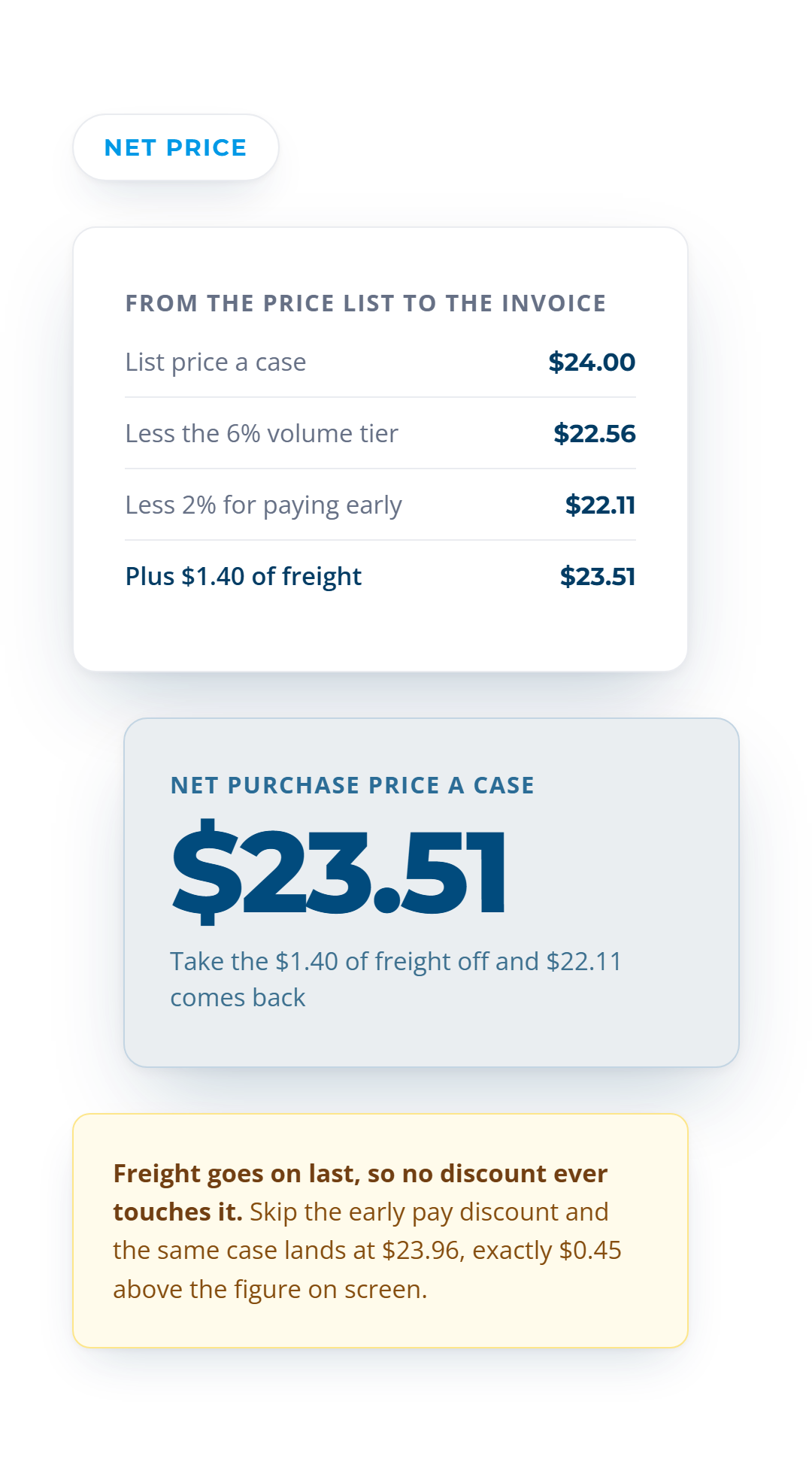
6% off $24.00 is $22.56, and 2% off that is $22.11. The order matters, because early pay comes off the already discounted price.
3

Enter your terms to price the discount as a rate

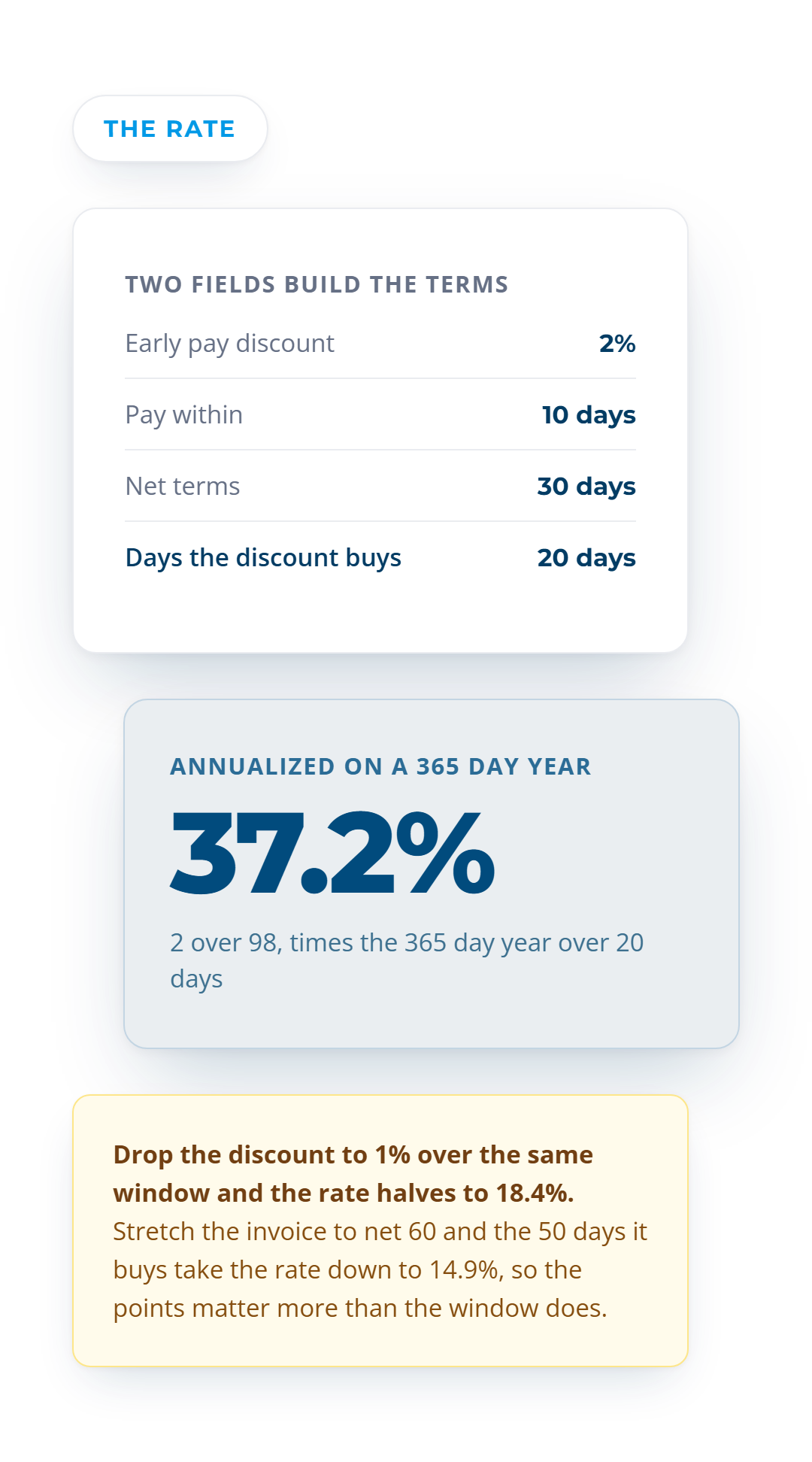
Pay within 10 days on net 30 terms and 2% buys you 20 days, which annualizes to 37.2% on the money.
What You See

What 2/10 net 30 is worth, and what the case really costs

A 2% discount for paying 20 days early, net 30 less a 10 day window, annualizes to 37.2% on a 365 day year, falling to 18.4% at 1% and to 14.9% on net 60 terms.
The rate

What paying early is worth as a yearly rate

2% to pay 20 days early annualizes to 37.2%. Move the window or the net terms and the rate moves with them, so you can price any offer you are given.
Builds the terms label from your two fields
Annualizes on a 365 day year
Names the days the discount buys
Blanks the rate when no window is left
Net price

What the case actually costs you

$22.11 after both discounts plus $1.40 of freight is $23.51 a case. Take the freight off the figure on screen and the discounted price comes back.
Settles every price to whole cents
Adds freight after the discounts, never before
Shows the discounted price beside the net price
Holds at any freight figure, including zero
A $24.00 list case drops to $22.56 after a 6% volume tier and $22.11 after 2% for paying early, then $1.40 of freight brings the net price to $23.51.
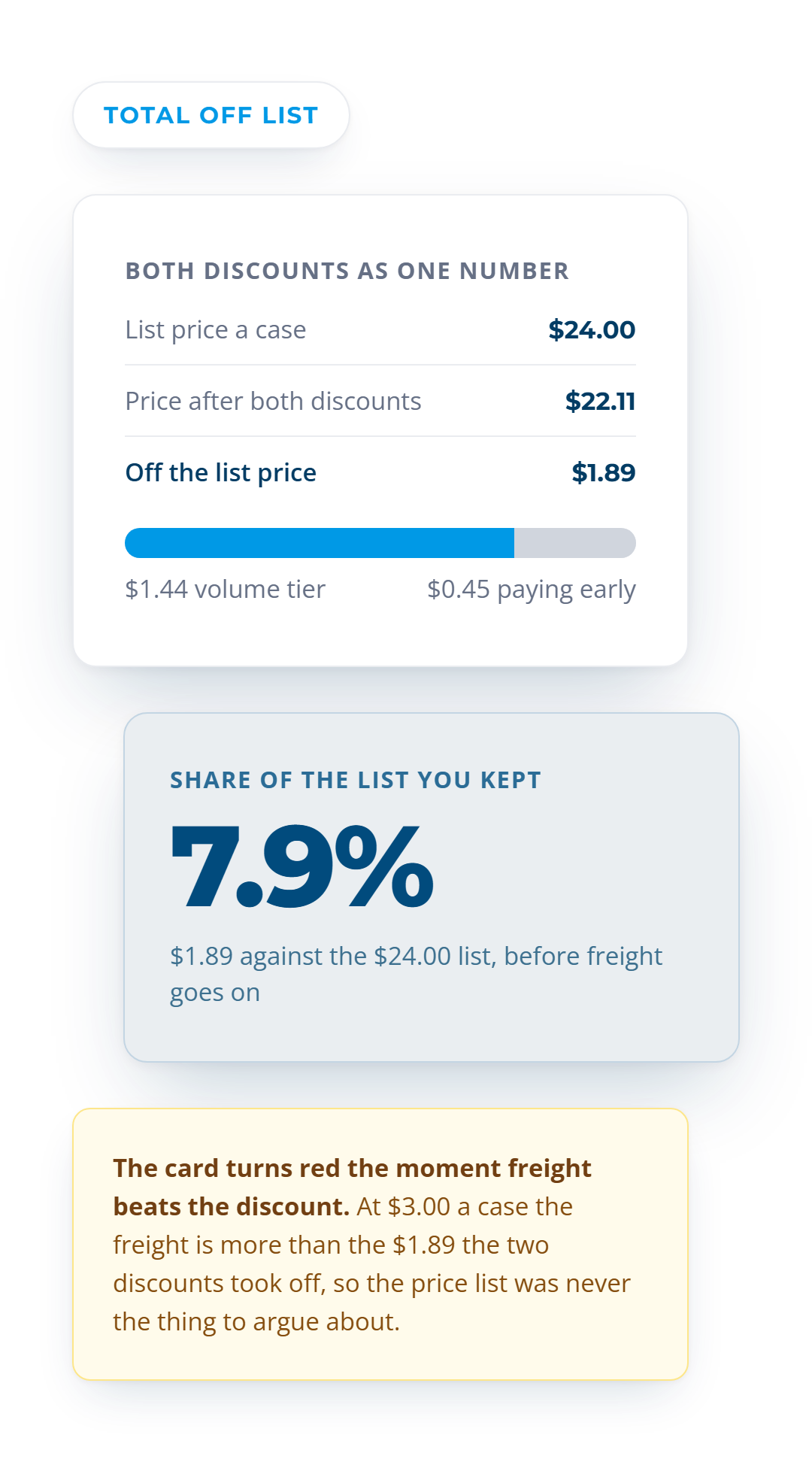
The $1.89 a case taken off the $24.00 list is 7.9%, split into $1.44 from the volume tier and $0.45 from paying early, before any freight goes on.
Total off list

How much of the list price you actually kept

$24.00 list less $22.11 is $1.89 a case, which is 7.9% off. The card turns red the moment the freight is bigger than the discount.
Reads both discounts as one number
Holds the discount against the freight
Turns red at $3.00 of freight
Works with no early pay discount at all
Cash value

What the discount is worth across a month

$0.45 a case across 6,000 cases is $2,700 a month, and your monthly spend on the item lands at $141,060 with the freight in.
Derives the saving from the cents on screen
Prints monthly spend beside the saving
Scales to any monthly volume
Survives a zero case month
A $0.45 saving a case between $22.56 and $22.11 is worth $2,700 across 6,000 cases a month, with monthly spend on the item landing at $141,060.
After The Numbers

What to do once you know what the discount is worth

A rate only pays off if the check leaves inside the window. These nine habits are what keep it honest.
Supplier invoice showing the payment terms

Ask every supplier for terms

Calendar marking the ten day discount window

Diary the discount window

Percent sign for the annualized rate on an invoice

Pay the highest rate invoices first

Checkmark confirming the remittance took the discount

Check the remittance took the points

Written list setting out the volume discount tier

Get the volume tier in writing

Dollar figure for a rebate kept on its own line

Keep rebates on their own line

Cases on one truck sharing a single freight charge

Split freight across the cases on the truck

Scale weighing the payment terms against the percent

Price the terms, not the percent

Rising case volume that moves the discount tier

Reprice the tier when volume moves

Six Levers

What actually decides whether early pay is worth taking

Four of these six are inputs on the calculator. The other two decide whether the answer is any use to you.
Price falling by the early payment discount points

The size of the discount

2% for 20 days is 37.2% a year. Drop it to 1% over the same window and the rate halves to 18.4%, so the points matter most.
Clock counting the days the discount buys

The days you actually buy

Net terms less the discount window. 2/10 net 30 buys 20 days, while 2/10 net 60 buys 50 days and drops the rate to 14.9%.
Cash on hand inside the discount window

Whether the cash is there in time

A 37.2% rate is worth nothing if the money is not in the account. Rank the invoices by rate and clear the top ones first.
Stacked cases behind the volume discount tier

The volume tier sitting under it

Early pay comes off the price after the volume discount. Drop the 6% tier and the same 2% is worth $2,880 a month, not $2,700.
Inbound freight that no discount reduces

Freight, which never gets discounted

$1.40 a case goes on after both discounts, which is why $22.11 becomes $23.51. No discount you negotiate ever touches it.
Monthly case volume the tier is promised against

Whether the tier holds all year

A discount tier is a promise about volume. Commit to 6,000 cases a month and the 6% only survives if that is what ships.

See how VOS keeps the order volume behind your tier accurate

VoiceOrder Solutions captures orders around the clock, and each account places them against its own order guide. The case volume you commit to is then the volume that actually shipped.
The Comparison

Three ways to handle an early payment discount, and which one holds up

Same $24.00 list, same 6% tier, same 2/10 net 30 on the invoice. These are the three ways the call gets made.

What you need before you decide to pay an invoice early

Pricing the terms as a yearly rate

Taking every discount you are offered

Paying everything at net terms

Turns the discount into a yearly rate
No, it never asks what the rate is
No, the policy is the answer
Prices the days you actually buy
No, 2/10 and 2/20 get treated the same
No, the 20 days never get priced
Takes the volume discount before the early pay one
Sometimes, it depends who keys the invoice
No
Keeps freight out of the discount
Usually, since freight sits on its own line
Yes, by giving up the discount entirely
Shows what a month of it is worth
No, nobody adds the savings up
No, there is no saving to count
Names the net price you really pay
No, it stops at the discount
Partly, the case lands at $23.96 instead of $23.51
Moves when the net terms move
No, the terms change and the habit does not
No, only the due date moves
Says when there is no discount left to take
No, it takes whatever the invoice offers
Yes, by never taking one
Where it falls down
It assumes the cash is in the account on time, and a rate cannot create cash
It spends cash on the low rate invoices first
It gives up the cheapest money a supplier will offer you
Best used for
Deciding which invoices to pay early when the cash is finite
A month where cash is not the constraint
A month where the cash genuinely is not there
FAQ

Common questions about early payment discounts

What is an early payment discount?
Points your supplier takes off the invoice if you pay before it is due. 2/10 net 30 means you keep 2% by paying inside 10 days on an invoice due in 30. On a $22.56 case that is $0.45, or $2,700 a month across 6,000 cases.
What is the typical discount for early payment?
Two percent inside ten days is the common one, and one percent inside ten days turns up almost as often. The points matter more than the window: 2% over 20 days annualizes to 37.2%, while 1% over the same 20 days is only 18.4%.
What does 2% 10 net 30 mean?
Keep 2% if you pay inside 10 days, or pay the full amount by day 30. All the discount buys is 20 days of float, which is why it is worth pricing as a rate. On this invoice that rate is 37.2% a year.
How does a prompt pay discount work?
The order of operations decides the number. Your volume discount comes off first, so $24.00 becomes $22.56, then the early pay discount comes off that for $22.11. Freight is added back last at $1.40 and never gets discounted.
What are the four types of discounts?
Trade or volume, cash or early pay, seasonal, and promotional. This calculator handles the first two, the 6% volume discount and the 2% early pay discount. Rebates paid back to you later belong on their own line, not inside the case price.
How do you record an early payment discount in accounting?
Your accountant decides where it lands, usually as a reduction of the purchase price rather than as income. The decision is the useful part. Taking 2/10 net 30 earns 37.2% a year on the cash, which beats what any credit line charges you.
Are prompt pay discounts legal?
Yes. An early payment discount is an ordinary commercial term you and your supplier agree, printed on the invoice as something like 2/10 net 30. Get it in writing alongside the volume tier, then check the remittance actually applied the 2% you took.

Buy against the volume your accounts actually ordered

VoiceOrder Solutions timestamps every order placed in it and keeps inventory visibility current. The 6,000 cases behind your discount tier are then the cases you really moved.